Interactive Urine-Formation Labelled Illustration
What is Urine Formation?
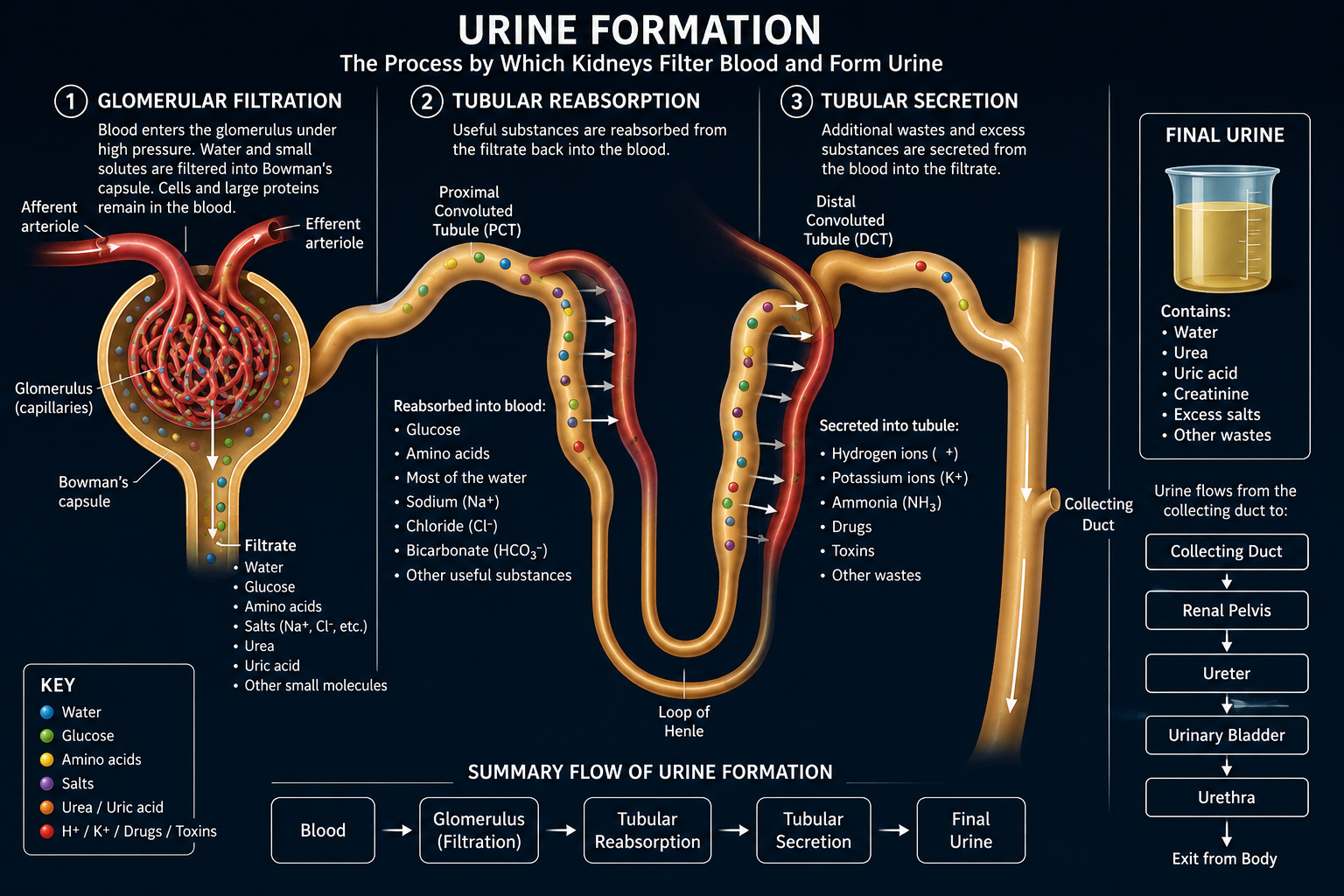
Urine formation is the process by which the kidneys filter blood to remove metabolic wastes, excess water, and harmful substances while conserving materials the body still needs. This process takes place inside millions of tiny filtering units called nephrons.
During urine formation, useful substances such as glucose, amino acids, most water, and essential salts are returned to the bloodstream, whereas waste products like urea, uric acid, creatinine, and excess ions are removed from the body in the form of urine.
By carefully controlling the composition of urine, the kidneys help maintain the body's internal balance, or homeostasis, by regulating water levels, electrolyte concentration, blood pH, and blood volume.
Where Does It Occur?
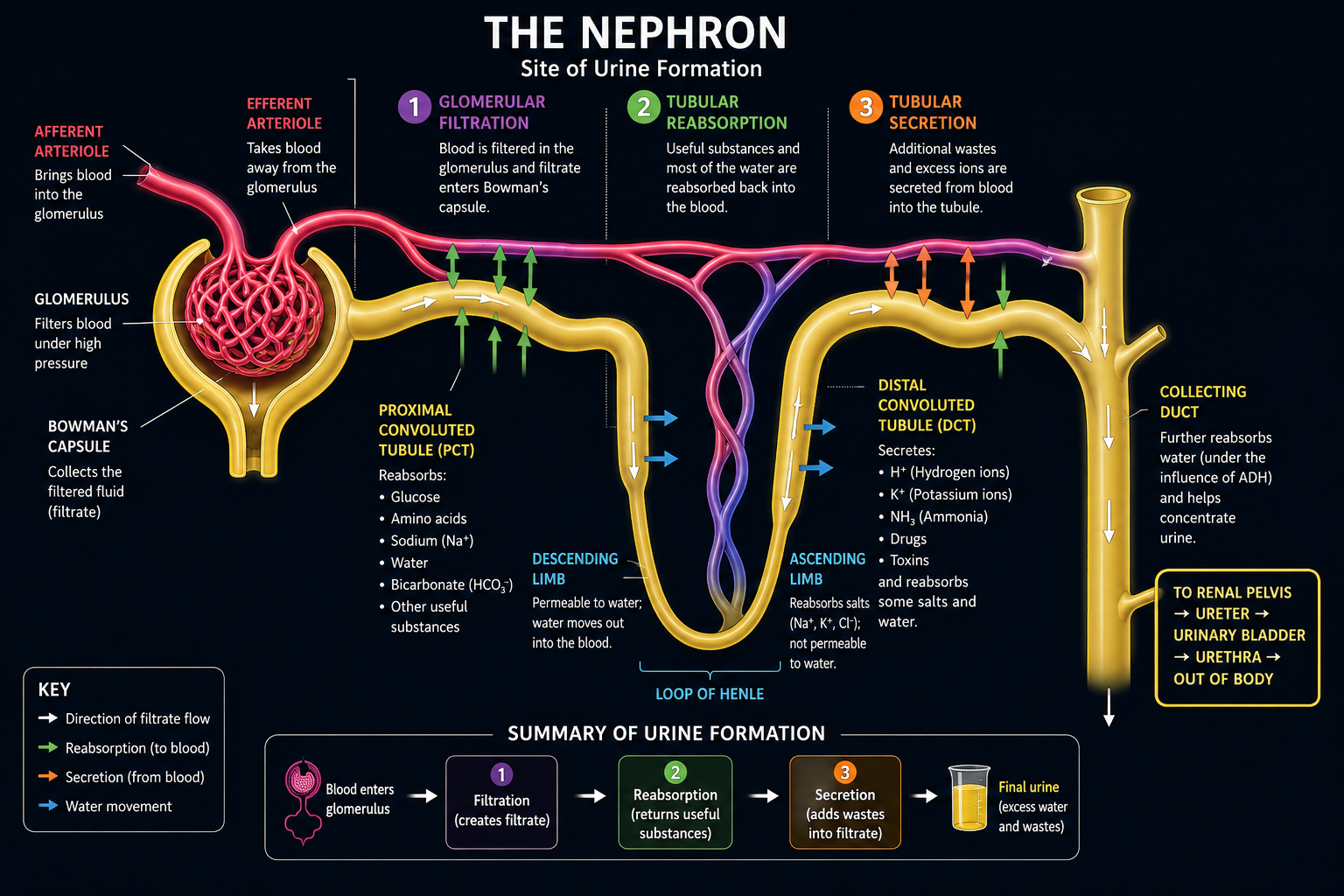
Urine formation takes place inside tiny filtering units called nephrons, which are found in the kidneys.
The Nephron
Each kidney contains over one million nephrons. Every nephron filters blood, removes wastes, and returns useful substances to the bloodstream.
The process begins when blood enters the glomerulus. As the filtrate moves through different parts of the nephron, useful materials are reabsorbed while additional wastes are secreted. The remaining fluid eventually becomes urine.
Three Steps of Urine Formation
Urine is produced through three important processes that take place inside the nephron. Together, these steps remove wastes while conserving substances the body still needs.
Glomerular Filtration
- Blood enters the glomerulus.
- Water and small molecules are filtered.
- Blood cells and proteins remain in the bloodstream.
Tubular Reabsorption
- Useful substances return to the blood.
- Glucose is reabsorbed.
- Amino acids are reabsorbed.
- Most water is reabsorbed.
- Some salts are reabsorbed.
Tubular Secretion
- Additional wastes are added to the filtrate.
- Hydrogen ions (H⁺)
- Potassium ions (K⁺)
- Drugs
- Toxins
Final Urine
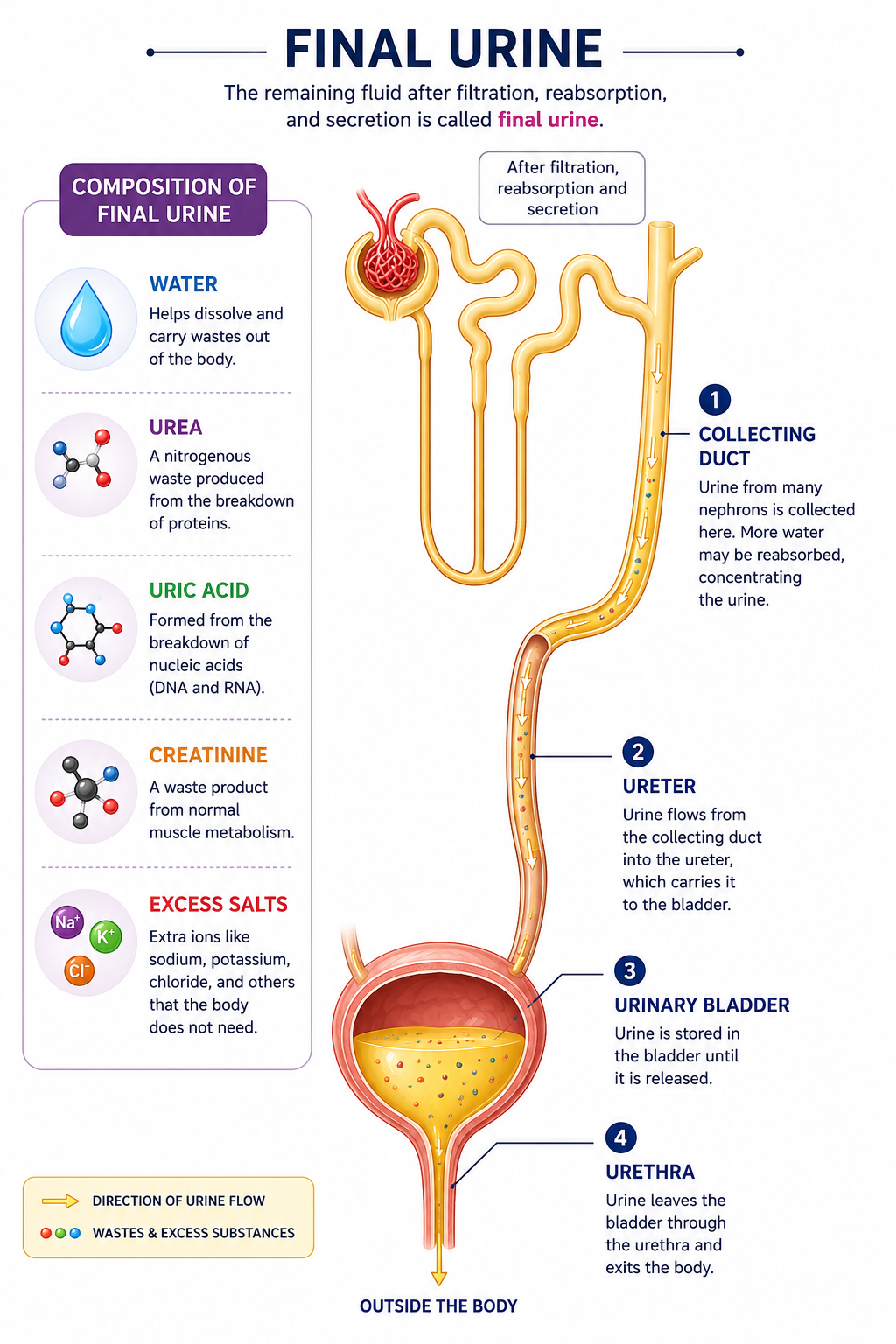
After filtration, reabsorption, and secretion are complete, the remaining fluid is called final urine. It contains waste products and excess substances that the body no longer needs.
Composition of Final Urine
Final urine is made up of water and dissolved waste products that are removed from the bloodstream to help maintain a healthy internal environment.
- 💧 Water – Removes excess water from the body while helping dissolve waste products.
- 🧪 Urea – A nitrogenous waste produced during the breakdown of proteins.
- ⚗️ Uric Acid – Formed from the breakdown of nucleic acids (DNA and RNA).
- 🩸 Creatinine – A waste product released during normal muscle metabolism.
- 🧂 Excess Salts – Extra sodium, potassium, chloride, and other ions removed to maintain electrolyte balance.
Pathway of Urine
Collecting Duct ↓ Ureter ↓ Urinary Bladder ↓ Urethra ↓ Outside the Body
Summary Flow Diagram
The complete journey of urine formation, from blood entering the kidney to urine leaving the body.
Factors Affecting Urine Formation
Several internal and external factors influence the amount and concentration of urine produced by the kidneys.
Water Intake
Drinking more water usually increases urine production, while dehydration reduces it.
Temperature
Hot weather causes more water loss through sweating, leading to less urine formation.
Blood Pressure
Blood pressure affects the rate at which blood is filtered inside the kidneys.
Hormones (ADH)
Antidiuretic Hormone (ADH) controls how much water is reabsorbed back into the bloodstream.
Salt Intake
Excess salt changes water balance, causing the kidneys to adjust urine concentration.
Medicines
Some medicines, especially diuretics, increase urine production by reducing water reabsorption.
Interesting Statistics
The kidneys work continuously to keep the body's internal environment balanced. Here are some fascinating facts and numbers about urine formation.
💧 180 L
Approximately 180 liters of filtrate are produced by both kidneys every day.
♻️ 99%
Nearly 99% of the filtrate is reabsorbed back into the bloodstream.
🚽 1–2 L
Only about 1–2 liters of urine are excreted daily in a healthy adult.
🫘 1 Million+
Each kidney contains more than one million nephrons.
🩸 50 Times
Your kidneys filter the body's entire blood supply around 50 times every day.
⚡ 1.2 L/min
About 1.2 liters of blood flow through the kidneys every minute.
⏱️ 24/7
The kidneys work continuously, even while you are sleeping.
💦 150–180 L
Almost 150–180 liters of water enter the nephrons each day before reabsorption.
🧪 3 Steps
Urine is formed through three essential processes: filtration, reabsorption, and secretion.
📏 30 cm
Each nephron is approximately 30 cm long if stretched out completely.
Amazing Urine Formation Facts
Here are some fascinating facts about urine formation and the incredible work your kidneys perform every day!
Your kidneys produce nearly 180 liters of filtrate every day, but only about 1–2 liters become urine.
About 99% of the filtered water and useful substances are reabsorbed back into the bloodstream.
Each kidney contains more than one million nephrons, where urine formation takes place.
Your kidneys filter the body's blood about 50 times every day.
Urea, one of the main components of urine, is produced when your body breaks down proteins.
Urine formation occurs through three major steps: filtration, reabsorption, and secretion.
Most of the water filtered by the kidneys never leaves your body—it is recycled back into the blood.
On hot days, your kidneys produce less urine because your body loses more water through sweat.
Some medicines, called diuretics, increase urine production by reducing water reabsorption.
Your kidneys receive nearly 20–25% of the blood pumped by the heart every minute.
After it is formed, urine travels through the collecting ducts, ureters, bladder, and urethra.
The kidneys constantly adjust the amount of salt in urine to keep body fluids balanced.
Healthy blood pressure is essential for proper filtration inside the kidneys.
The hormone ADH helps control how much water is reabsorbed before urine is formed.
Creatinine in urine comes from the normal breakdown of muscle cells.
Even though nephrons are microscopic, together they filter hundreds of liters of fluid every day.
Your kidneys never stop making urine—even while you're asleep.
The color of urine often reflects how hydrated your body is.
Drinking more water usually results in larger amounts of lighter-colored urine.
Urine formation is one of the body's most important processes for maintaining homeostasis.
💡 Did you know?
Although your kidneys produce about 180 liters of filtrate every day, they return nearly 99% of it to your bloodstream. If they didn't, you would lose all your body water in just a few hours!