Interactive Nephron Labelled Illustration
Structure of the Nephron
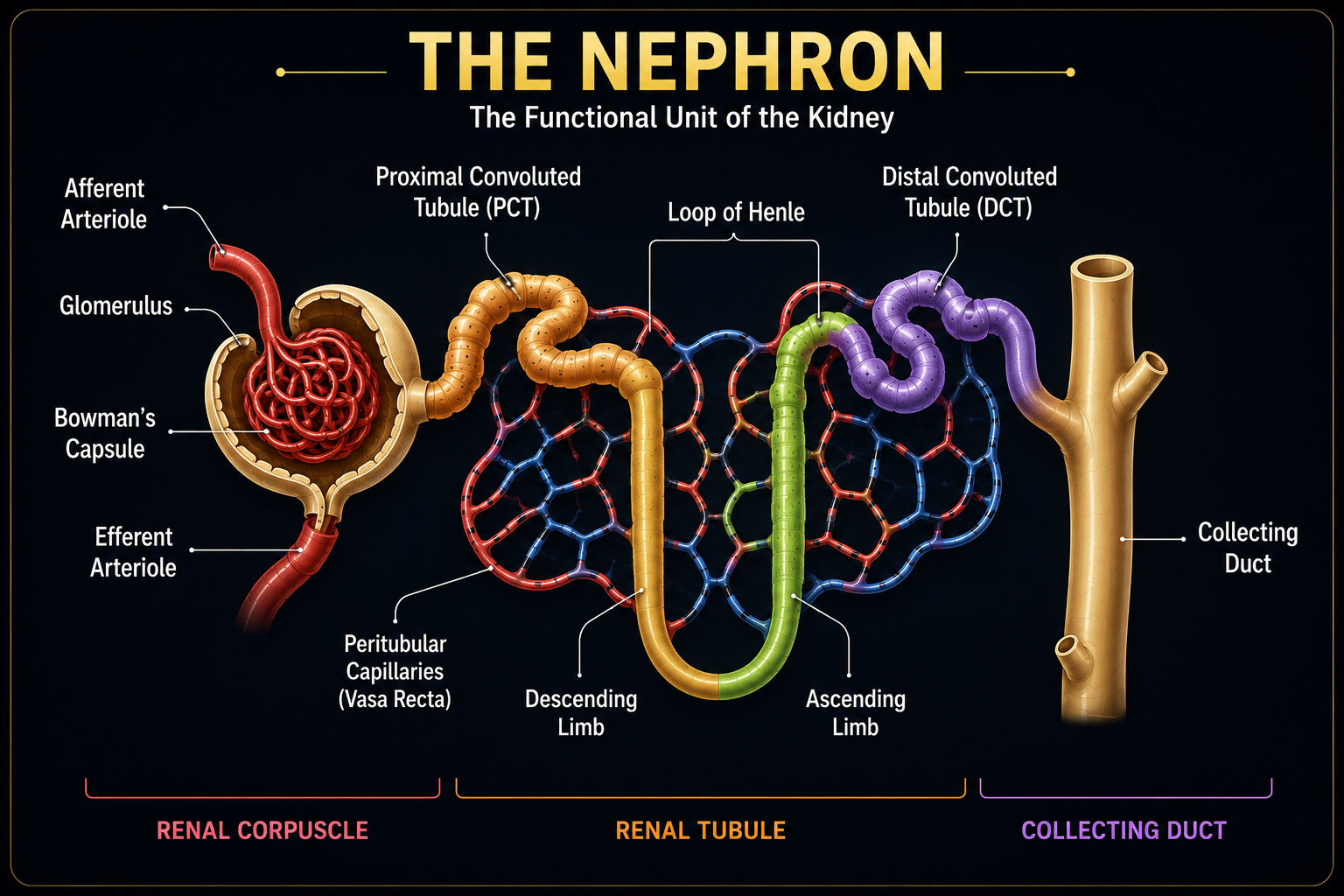
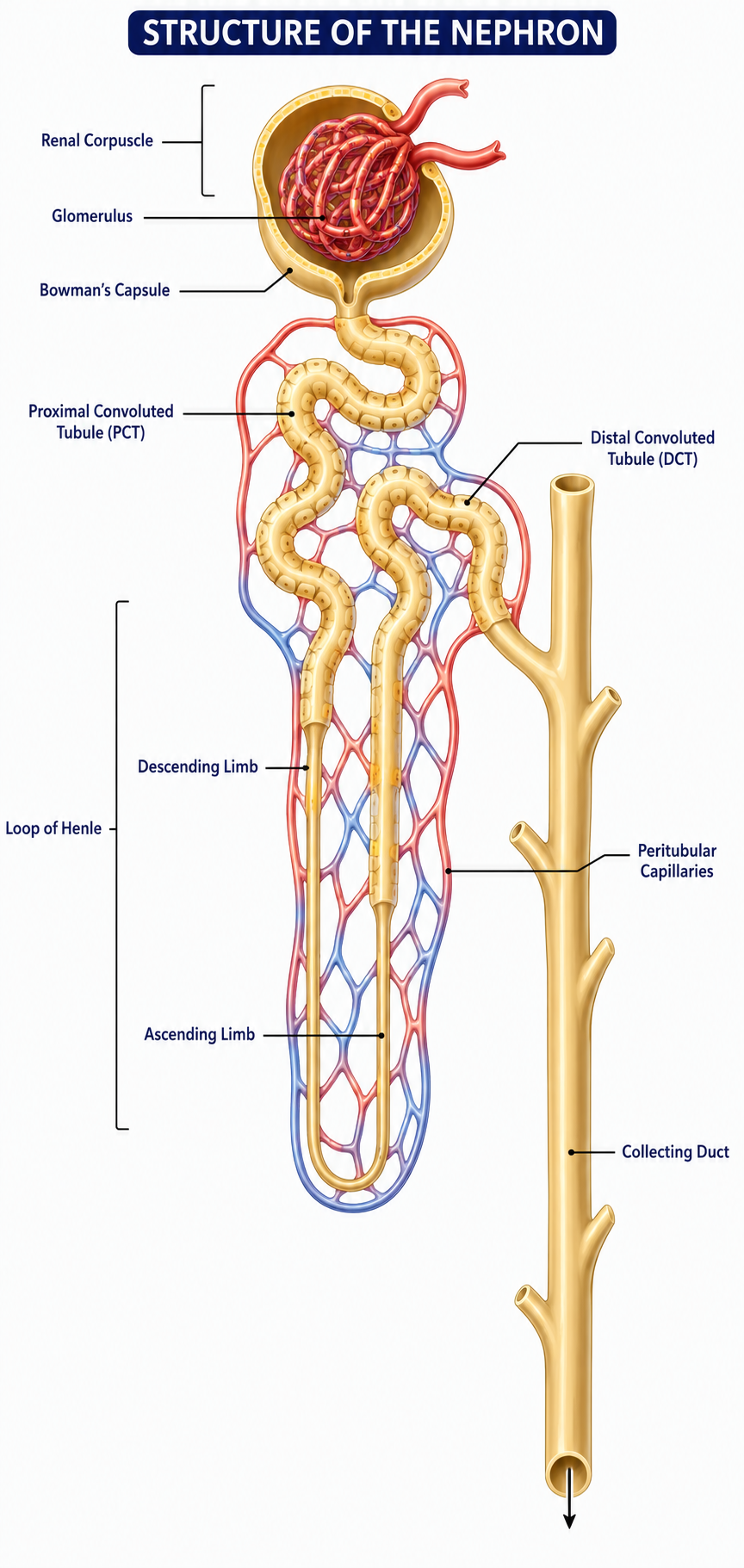
A nephron is composed of several specialized parts that work together to filter blood, reabsorb useful substances, remove wastes, and ultimately produce urine.
🔴 Renal Corpuscle
The renal corpuscle is the starting point of every nephron. It consists of the glomerulus and Bowman's capsule, where blood filtration begins.
🩸 Glomerulus
The glomerulus is a network of tiny capillaries that filters water, salts, glucose, amino acids, and wastes from the blood while preventing blood cells and proteins from passing through.
🟡 Bowman's Capsule
Bowman's capsule surrounds the glomerulus and collects the filtrate produced during filtration before it enters the renal tubule.
🟠 Proximal Convoluted Tubule (PCT)
The PCT is the first coiled part of the nephron where most water, glucose, amino acids, and essential salts are reabsorbed into the bloodstream.
🟢 Loop of Henle
The Loop of Henle extends deep into the kidney and plays an important role in concentrating urine by controlling the movement of water and salts.
⬇️ Descending Limb
The descending limb is highly permeable to water. As filtrate passes through, a large amount of water is reabsorbed into the surrounding tissues.
⬆️ Ascending Limb
The ascending limb reabsorbs sodium and chloride ions while remaining impermeable to water, helping maintain the kidney's concentration gradient.
🟣 Distal Convoluted Tubule (DCT)
The DCT performs selective reabsorption and secretion of ions, helping regulate electrolyte balance and blood pH.
🚰 Collecting Duct
The collecting duct receives filtrate from many nephrons. Additional water may be reabsorbed here before the final urine is transported toward the renal pelvis.
🫀 Peritubular Capillaries
The peritubular capillaries surround the nephron tubules and absorb water, nutrients, and ions that are reabsorbed from the filtrate back into the bloodstream.
Blood Flow Through the Nephron
Blood enters the nephron through a series of blood vessels, gets filtered in the glomerulus, exchanges substances with surrounding tubules, and finally returns to the bloodstream.
🩸 Blood Enters the Kidney
Blood carrying oxygen, nutrients, and waste products enters the kidney through the renal artery. It then branches into smaller arteries until it reaches the afferent arteriole, which delivers blood to the nephron.
🔬 Filtration in the Glomerulus
Inside the glomerulus, high blood pressure forces water and small dissolved substances into Bowman's capsule. Large proteins and blood cells remain in the bloodstream.
🔵 Blood Leaves the Glomerulus
After filtration, blood exits through the efferent arteriole, which forms a network of peritubular capillaries surrounding the nephron tubules.
♻️ Reabsorption & Exchange
The peritubular capillaries collect water, glucose, amino acids, and ions that are reabsorbed from the nephron, while some wastes are secreted back into the tubule.
❤️ Clean Blood Returns
Once filtration and exchange are complete, the purified blood leaves the kidney through the renal vein and returns to the heart to circulate throughout the body.
Filtrate Flow Through the Nephron
After blood is filtered in the glomerulus, the resulting filtrate travels through different parts of the nephron. At each stage, its composition changes as useful substances are reabsorbed and wastes are added.
🟡 Bowman's Capsule
The filtrate begins its journey here immediately after blood is filtered in the glomerulus. It contains water, salts, glucose, amino acids, and waste products.
🟠 Proximal Convoluted Tubule (PCT)
Most useful substances such as glucose, amino acids, salts, and water are reabsorbed back into the bloodstream, making the filtrate more concentrated.
🟢 Loop of Henle
Water is removed in the descending limb, while salts are reabsorbed in the ascending limb. This creates the concentration gradient needed for efficient urine formation.
🔵 Distal Convoluted Tubule (DCT)
The filtrate is adjusted further by selectively reabsorbing ions and secreting additional wastes, helping maintain electrolyte balance and blood pH.
🟣 Collecting Duct → 🚰 Renal Pelvis
The collecting duct performs the final adjustment of water content before the completed urine flows into the renal pelvis, ready to enter the ureter.
Functions of Each Part of the Nephron
Every part of the nephron has a specific job. Together, these structures filter blood, recover useful substances, remove wastes, and produce urine.
Glomerulus
Performs ultrafiltration by filtering water and small dissolved substances from the blood while retaining blood cells and large proteins.
Bowman's Capsule
Collects the glomerular filtrate produced during filtration and directs it into the renal tubule for further processing.
Proximal Convoluted Tubule (PCT)
Reabsorbs most of the water, glucose, amino acids, salts, and other useful substances back into the bloodstream.
Loop of Henle
Concentrates the filtrate by reabsorbing water in the descending limb and salts in the ascending limb.
Distal Convoluted Tubule (DCT)
Fine-tunes the composition of the filtrate through selective reabsorption and secretion, helping regulate pH and electrolyte balance.
Collecting Duct
Performs the final adjustment of water reabsorption and carries the completed urine toward the renal pelvis.
Amazing Nephron Facts
The nephron is one of the most remarkable microscopic structures in the human body. Here are some fascinating facts about the kidney's functional unit!
Every nephron is microscopic, yet it performs complex filtration that keeps you alive.
Each healthy kidney contains more than 1 million nephrons.
Together, both kidneys contain over 2 million nephrons.
Nephrons help produce nearly 180 liters of filtrate every day.
About 99% of the filtrate is reabsorbed before urine is formed.
Only about 1–2 liters become urine each day.
Every nephron works continuously, 24 hours a day, without resting.
The glomerulus inside each nephron is a tiny bundle of capillaries specially designed for filtration.
The filtration process begins because the blood inside the glomerulus is under high pressure.
The nephron can decide how much water should be returned to the body.
Nephrons carefully regulate the body's salt and mineral balance.
They also help maintain the correct blood pH by removing excess acids.
Useful substances like glucose and amino acids are normally reabsorbed instead of being lost in urine.
Healthy nephrons prevent blood cells and large proteins from entering the filtrate.
Each nephron contains a long tubule that is folded and coiled to maximize surface area.
The Loop of Henle creates a concentration gradient that allows humans to produce concentrated urine.
Nephrons help control blood pressure by regulating water and salt levels.
A nephron starts filtering blood the moment it receives it—every second of your life.
Unlike many other cells in the body, destroyed nephrons usually cannot regenerate.
You can lose nearly half of your nephrons before noticeable symptoms of kidney disease appear, which is why kidney damage often goes undetected in its early stages.
💡 Did you know?
If you could unfold the tiny tubules of all the nephrons in both of your kidneys and place them end to end, they would stretch for nearly 100 kilometers (about 62 miles)—yet all of this incredible filtration system fits inside two organs no bigger than your fists.