OVERVIEW

What Is the Muscular System?

Muscular System

The muscular system is one of the major organ systems of the human body, responsible for producing movement, maintaining posture, and generating heat. It is made up of more than 600 muscles that work together with the bones, joints, and nervous system to perform both voluntary and involuntary actions. The muscular system consists of three types of muscles: skeletal muscles, which control voluntary body movements; smooth muscles, which regulate the functions of internal organs; and cardiac muscle, which forms the heart and pumps blood throughout the body. Besides enabling physical activities such as walking, running, and lifting objects, the muscular system also helps stabilize joints, protects internal organs, supports body balance, and maintains a constant body temperature by producing heat during muscle contractions. Working closely with other body systems, it is essential for everyday activities and overall health.
Interactive 3D Human muscular System

Rotate, zoom and inspect the human muscular System to explore its structure from every angle.

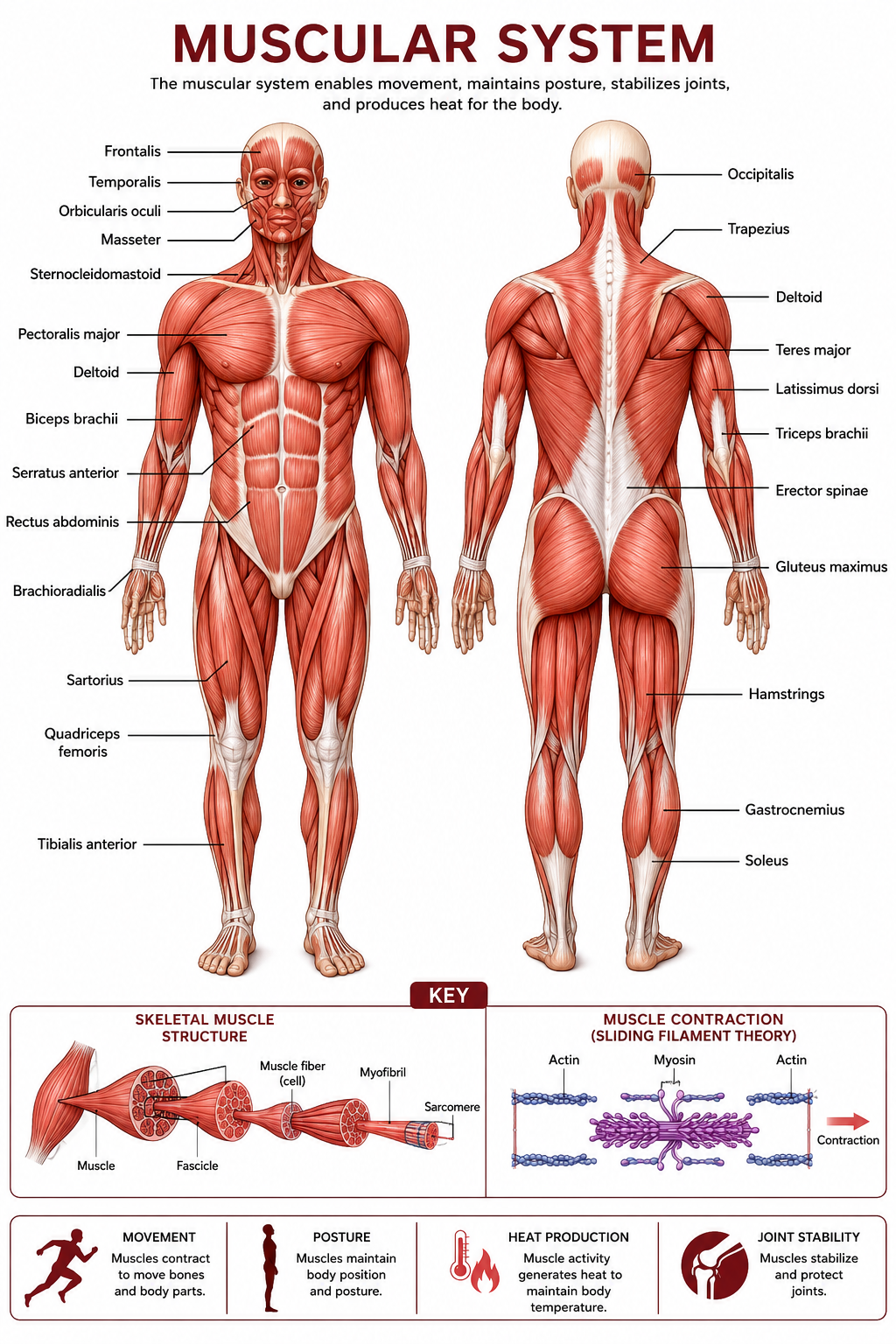
muscular System Labelled Illustrations

muscular System

Human muscular System

Main Purpose of the Muscular System

The muscular system enables movement, maintains posture, stabilizes joints, and produces heat to help the body function efficiently.

πŸ’ͺ

Movement

Muscles contract and relax to move the body, allowing activities such as walking, running, lifting, and even facial expressions.

🧍

Maintains Posture

Skeletal muscles continuously work to keep the body upright and maintain balance while standing, sitting, or moving.

🦴

Stabilizes Joints

Muscles support and protect joints by holding bones in the correct position during movement.

πŸ”₯

Produces Heat

Muscle contractions generate heat, helping maintain a stable body temperature and keeping the body warm.

Major Components

The muscular system is made up of three different types of muscles, each specially designed for a unique function in the body.

πŸ’ͺ

Skeletal Muscle

Voluntary muscles attached to bones that allow movement, posture, and body stability.

❀️

Cardiac Muscle

Specialized involuntary muscle found only in the heart that pumps blood continuously.

🫁

Smooth Muscle

Involuntary muscle found in internal organs such as the stomach, intestines, and blood vessels.

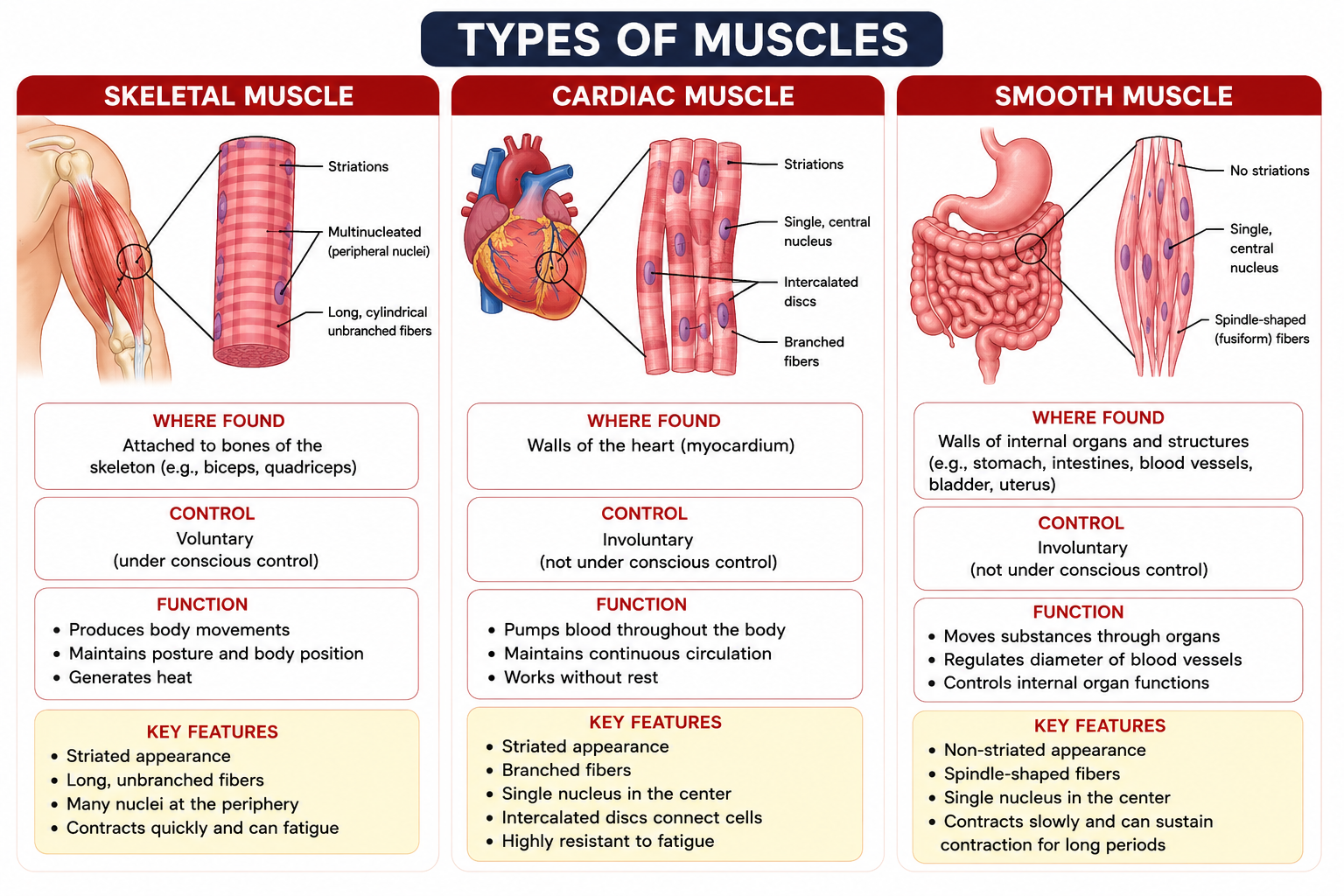
Types of Muscles

The human body contains three different types of muscles. Each type has a unique structure, location, and function.

Muscle Type Location Control
πŸ’ͺ Skeletal Attached to Bones Voluntary
🫁 Smooth Walls of Internal Organs Involuntary
❀️ Cardiac Heart Involuntary
Types of Muscles Illustration

Structure of Muscles

Although all muscles are made of muscle cells, their internal organization differs depending on their function. Skeletal muscle has the most complex structure, while cardiac and smooth muscles have specialized arrangements.

πŸ’ͺ Skeletal Muscle

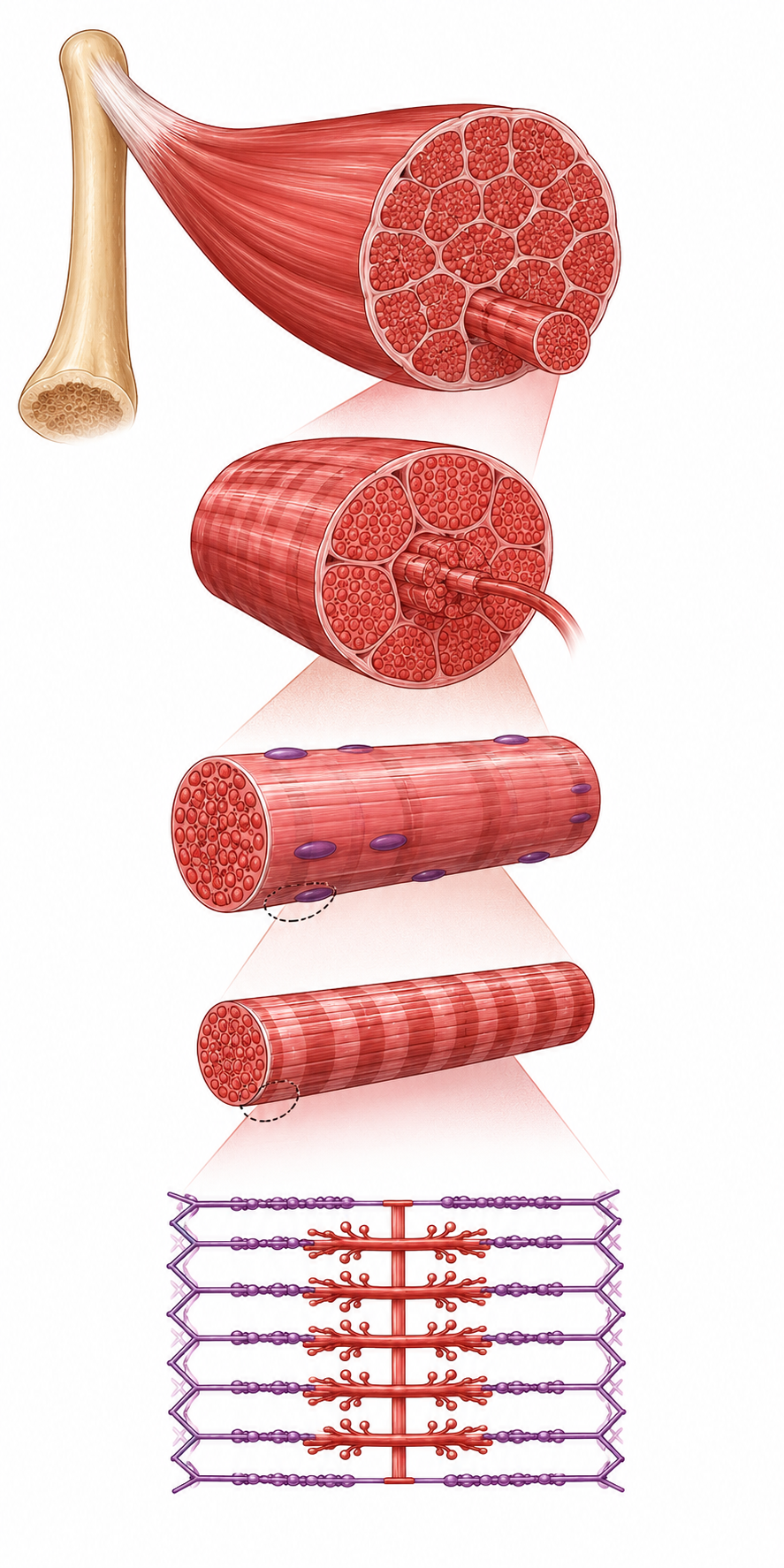
Skeletal muscles are highly organized. Each large muscle is made up of bundles called fascicles. Fascicles contain many muscle fibers, which are packed with myofibrils. Myofibrils are composed of repeating units called sarcomeres, the functional units responsible for muscle contraction.

πŸ’ͺ Muscle
↓
πŸ“¦ Fascicle
↓
🧬 Muscle Fiber
↓
🧡 Myofibril
↓
βš™οΈ Sarcomere
Structure of Skeletal Muscle

❀️ Cardiac Muscle

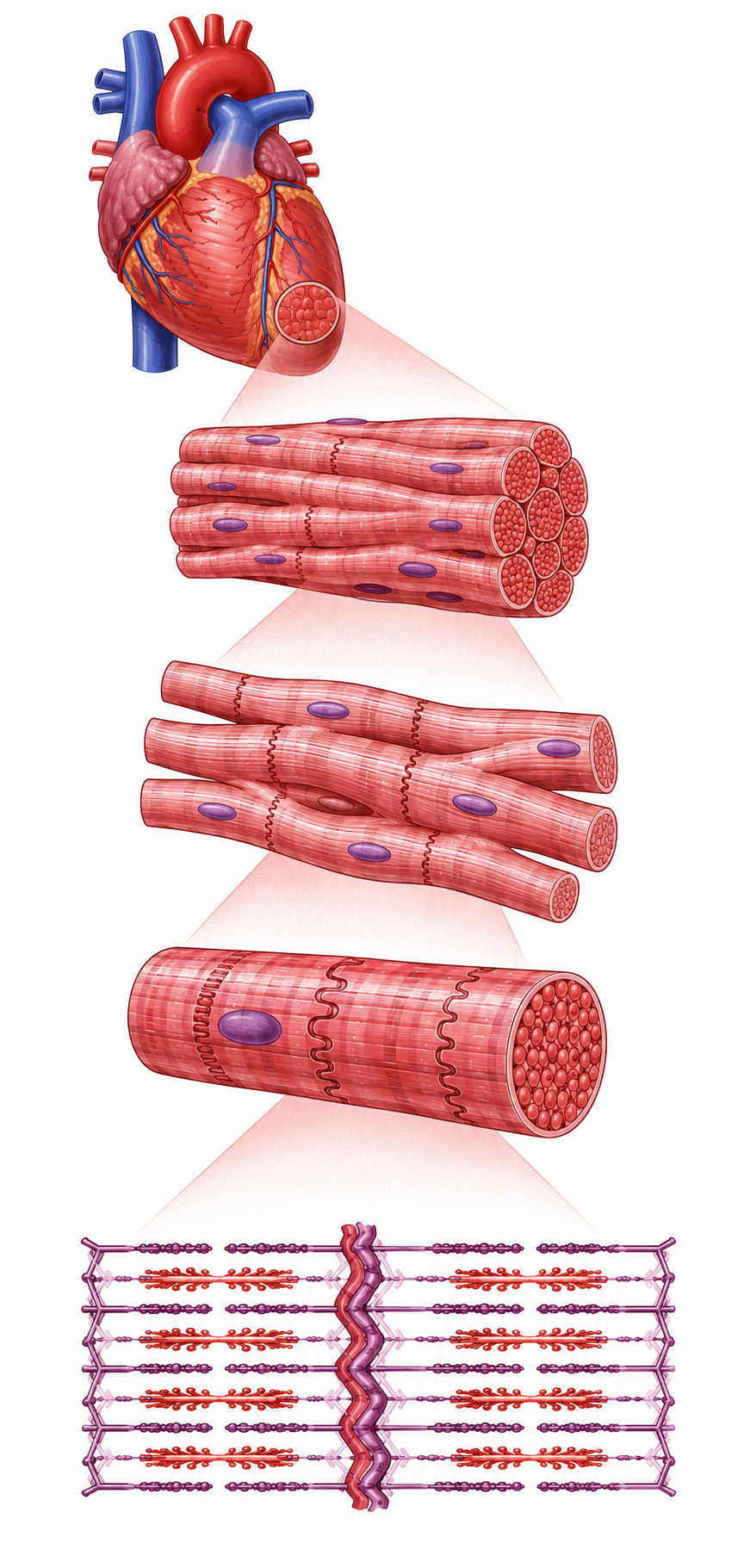
Cardiac muscle is made of short, branched muscle fibers connected by intercalated discs. These special connections allow electrical signals to spread rapidly, enabling the heart to contract as a single powerful pump.

❀️ Heart Wall
↓
🌿 Branched Cardiac Fibers
↓
πŸ”— Intercalated Discs
↓
⚑ Coordinated Contraction
Structure of Cardiac Muscle

🫁 Smooth Muscle

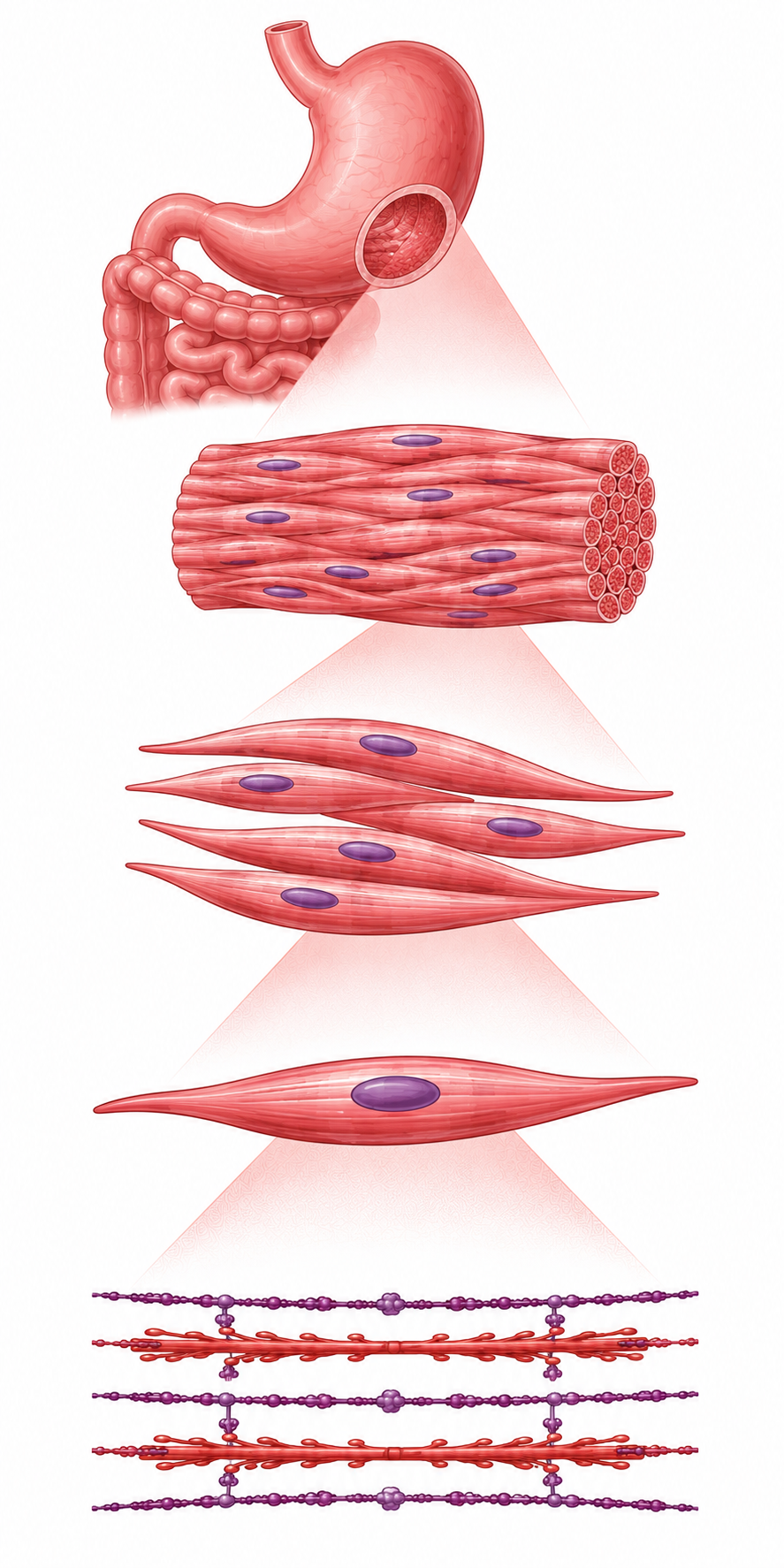
Smooth muscles consist of spindle-shaped muscle cells with a single nucleus. Unlike skeletal muscle, they do not contain visible striations. These cells work together to produce slow, sustained contractions in internal organs.

🫁 Organ Wall
↓
πŸͺΆ Smooth Muscle Cells
↓
πŸ”„ Coordinated Layers
↓
βš™οΈ Slow Contraction
Structure of Smooth Muscle

Major Muscles of the Human Body

The human body contains hundreds of muscles, but some play a major role in movement, posture, and everyday activities. Click on any muscle to learn more.

🦾

Biceps

πŸ’ͺ

Triceps

πŸ›‘οΈ

Deltoid

❀️

Pectoralis Major

🦡

Quadriceps

🦡

Hamstrings

🦢

Gastrocnemius

πŸ‹οΈ

Gluteus Maximus

Sliding Filament Theory

The Sliding Filament Theory explains how muscles contract. During contraction, thin actin filaments slide over thick myosin filaments, shortening the sarcomere and producing movement.

How Muscle Contraction Occurs

Muscle contraction is powered by the interaction of actin and myosin. The process requires ATP for energy and calcium ions (Ca²⁺) to expose binding sites on actin.

🧡

Actin

Thin filaments that slide inward during contraction.

βš™οΈ

Myosin

Thick filaments with heads that pull on actin.

⚑

ATP

Provides the energy required for repeated contractions.

πŸ§ͺ

Calcium

Allows myosin heads to attach to actin.

πŸ§ͺ Calcium Released
➜
βš™οΈ Myosin Binds Actin
➜
⚑ ATP Powers Pull
➜
πŸ’ͺ Muscle Contracts
Sliding Filament Theory

Muscles Working Together

Most body movements require several muscles to work together. Each muscle has a specific role that helps produce smooth, controlled, and efficient movement.

πŸ’ͺ

Agonist

The prime mover that produces the main action during a movement.

Example: Biceps during elbow flexion.
βš–οΈ

Antagonist

The muscle that opposes the action of the agonist and helps control movement.

Example: Triceps during elbow flexion.
🀝

Synergist

Assists the agonist by adding extra force and reducing unnecessary movements.

Works together with the prime mover.
πŸ›‘οΈ

Fixator

Stabilizes bones or joints so the agonist can work efficiently without unwanted movement.

Provides a stable base for movement.

Keeping Your Muscles Healthy

Healthy muscles require proper nutrition, regular activity, and adequate recovery. These simple habits help muscles stay strong and function efficiently.

πŸ₯©

Protein

Protein provides the building blocks needed to repair and grow muscle tissue.

πŸ‹οΈ

Exercise

Regular physical activity strengthens muscles and improves endurance and flexibility.

πŸ’§

Hydration

Drinking enough water helps muscles contract properly and reduces the risk of cramps.

😴

Rest

Muscles repair and become stronger during rest and quality sleep.

🀸

Stretching

Stretching improves flexibility, increases mobility, and helps prevent injuries.

Muscular System in Numbers

The muscular system is one of the most active and powerful systems in the human body. Here are some amazing facts and statistics!

600+

Muscles work together to move your body.

40%

Of an average person's body weight is skeletal muscle.

650+

Named muscles have been identified in the human body.

3

Main muscle types: Skeletal, Cardiac, and Smooth.

100+

Facial muscles help create different expressions.

24/7

Your heart muscle works continuously without resting.

70%

Approximately 70–75% of muscle tissue is water.

50%

Nearly half of your muscles are located in your legs and hips.

1,000+

Muscle fibers can be activated during a single powerful movement.

1

The Gluteus Maximus is the largest muscle in the human body.

Did You Know?

πŸ’ͺ