Interactive Kidney Labelled Illustration
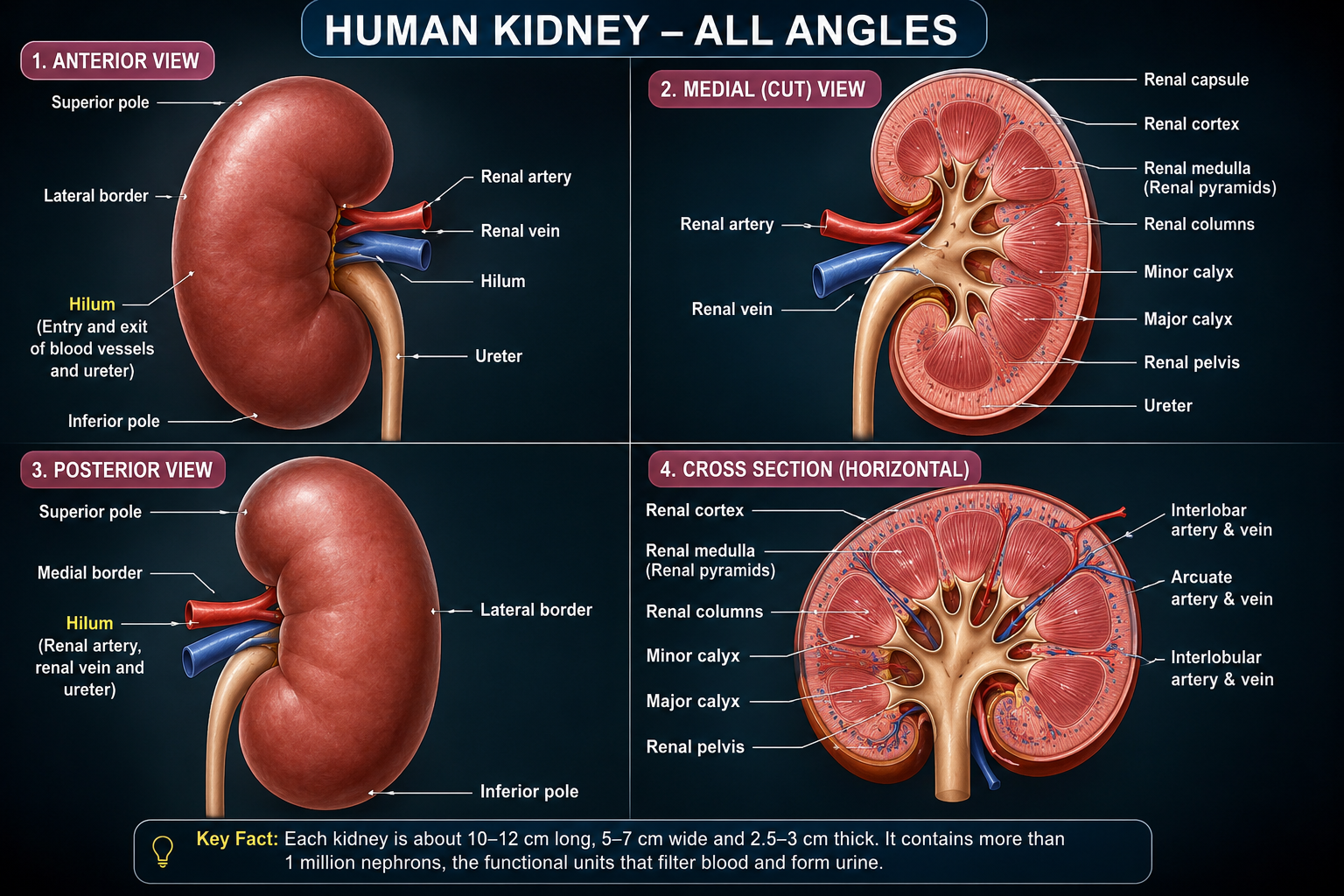
External Structure of the Kidney
The kidney has several external structures that protect it, supply blood, and transport urine to the urinary bladder.
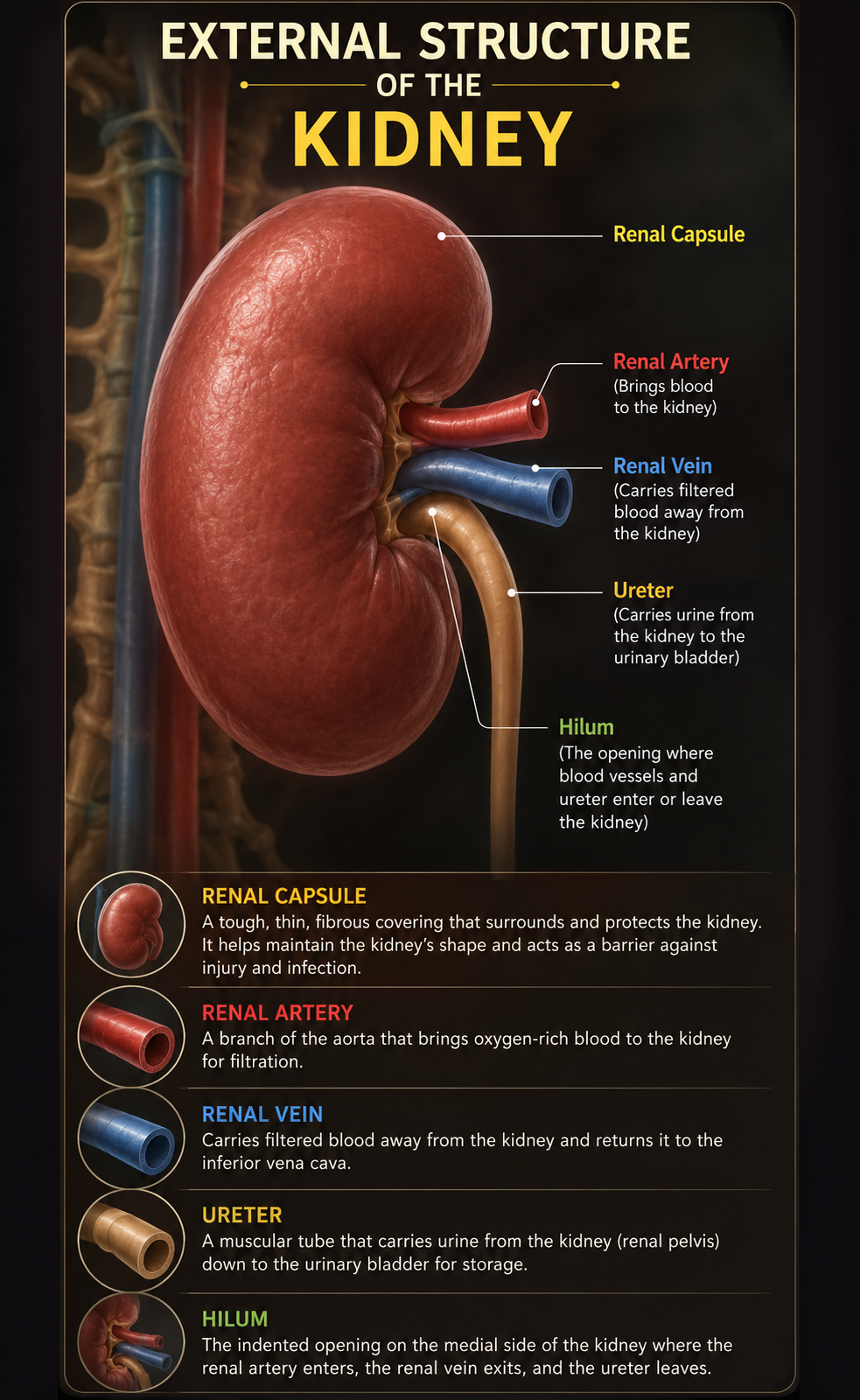
🛡️ Renal Capsule
A thin, tough layer of connective tissue that surrounds and protects the kidney from injury and infection.
🩸 Renal Artery
Carries oxygen-rich blood from the heart to the kidney so that it can be filtered.
🔵 Renal Vein
Returns the filtered blood from the kidney back to the heart.
🚰 Ureter
A narrow muscular tube that transports urine from the kidney to the urinary bladder.
🟡 Hilum
The indented opening on the inner side of the kidney where the renal artery enters, the renal vein leaves, and the ureter begins.
Internal Structure of the Kidney
A cross-section of the kidney reveals several specialized regions that work together to filter blood, collect urine, and transport it out of the body.
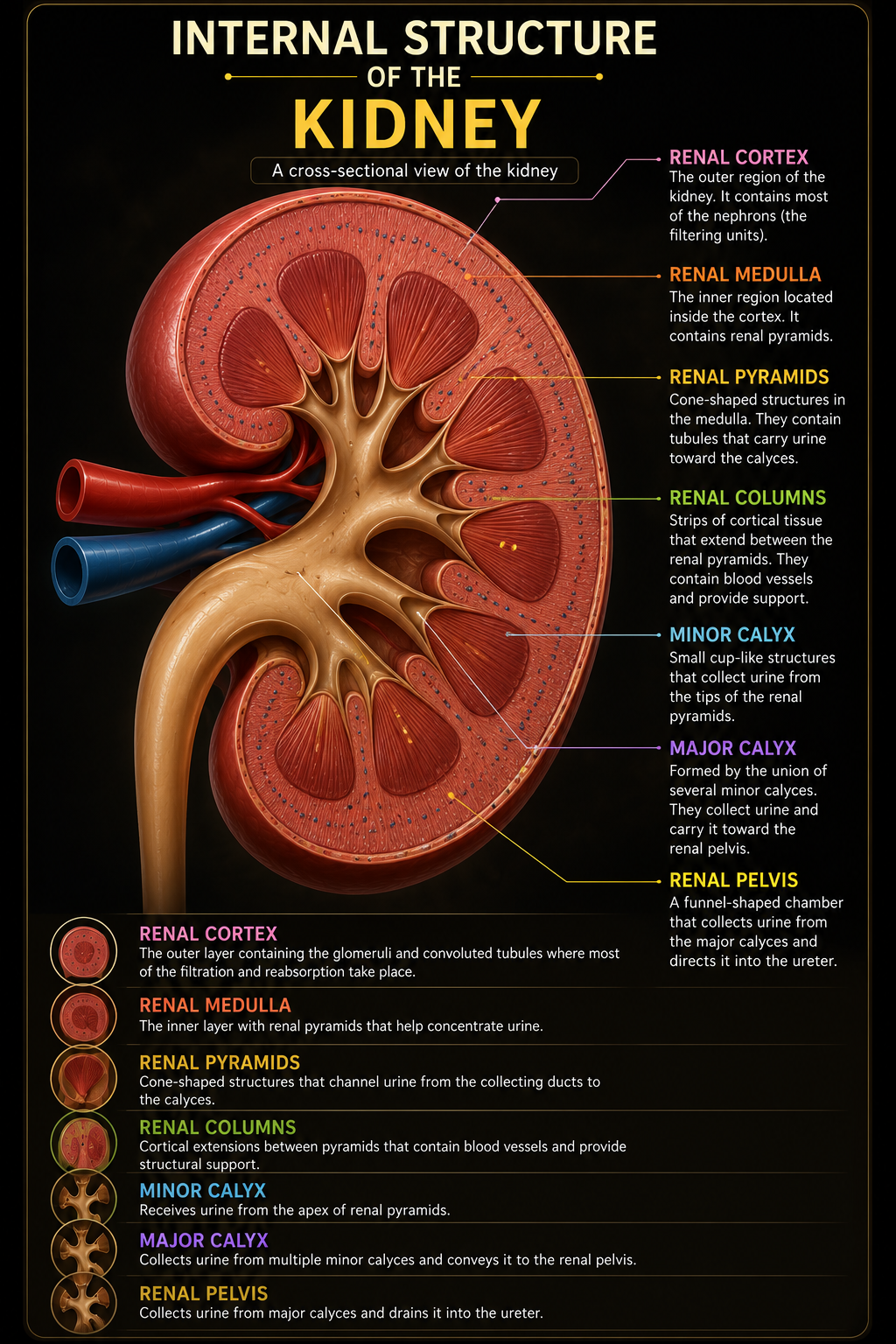
🟤 Renal Cortex
The outer region of the kidney where filtration begins. It contains millions of nephrons and glomeruli.
🔺 Renal Medulla
The inner region of the kidney that contains the renal pyramids and helps concentrate urine.
🔻 Renal Pyramids
Cone-shaped structures within the medulla that contain tubules carrying urine toward the calyces.
🧱 Renal Columns
Extensions of the renal cortex that separate adjacent renal pyramids and support Kidnry.
🟡 Minor Calyx
Small cup-shaped chambers that collect urine from the tips of the renal pyramids.
🟠 Major Calyx
Larger chambers formed by the joining of several minor calyces before urine enters the renal pelvis.
🚰 Renal Pelvis
A funnel-shaped cavity that collects urine from the major calyces and passes it into the ureter.
Blood Supply of the Kidney
The kidneys receive a rich blood supply to continuously filter wastes, regulate water balance, and maintain homeostasis.
🩸 Step 1 — Blood Enters
Oxygen-rich blood enters each kidney through the renal artery, which divides into smaller arteries that reach millions of nephrons.
🔬 Step 2 — Blood is Filtered
Inside the glomerulus, water and small dissolved substances are filtered from the blood while blood cells and proteins remain inside the Kidnry.
🔄 Step 3 — Blood Leaves
After filtration and exchange in the capillaries, the cleaned blood leaves the kidney through the renal vein and returns to the heart.
Functions of the Kidney
The kidneys perform several vital functions that keep the body healthy by maintaining the composition of blood and body fluids.
Blood Filtration
Filters the blood to remove harmful wastes, toxins, and excess substances while keeping useful materials in circulation.
Water Balance
Regulates the amount of water in the body by adjusting how much water is reabsorbed or excreted as urine.
Electrolyte Balance
Maintains the proper levels of important minerals such as sodium, potassium, calcium, and chloride.
pH Regulation
Helps maintain the normal pH of blood by removing excess acids and conserving bicarbonate ions.
Hormone Production
Produces hormones that help regulate blood pressure, red blood cell production, and calcium balance.
Waste Removal
Eliminates metabolic wastes such as urea, uric acid, creatinine, and excess salts through urine.
Keeping Your Kidneys Healthy
Healthy lifestyle habits help your kidneys work efficiently throughout your life and reduce the risk of kidney disease.
Stay Hydrated
Drink enough water each day to help the kidneys remove wastes and maintain proper fluid balance.
Healthy Diet
Eat a balanced diet rich in fruits, vegetables, and whole grains while limiting excess salt and processed foods.
Exercise Regularly
Regular physical activity improves blood circulation and helps maintain a healthy body weight.
Avoid Smoking
Smoking damages blood vessels, reducing blood flow to the kidneys and increasing the risk of kidney disease.
Use Medicines Wisely
Avoid unnecessary use of painkillers and always take medicines according to a healthcare professional's advice.
Regular Checkups
Routine medical checkups help detect kidney problems early before serious damage occurs.
Kidney Statistics
The kidneys are small organs with an enormous workload. These numbers show just how powerful and efficient they are.
🫘 2
Most healthy adults have two kidneys working together.
📏 10–12 cm
Each kidney is approximately 10–12 centimeters long.
⚖️ 150 g
One healthy kidney weighs around 150 grams.
🔬 1 Million+
Each kidney contains more than one million nephrons.
🩸 20–25%
The kidneys receive about 20–25% of the heart's blood output every minute.
💧 180 L
Together, the kidneys produce nearly 180 liters of filtrate every day.
♻️ 99%
Almost 99% of the filtrate is reabsorbed back into the bloodstream.
🚽 1–2 L
Only about 1–2 liters of urine are excreted daily.
❤️ 24/7
Your kidneys work continuously, even while you are sleeping.
🔄 50 Times
The kidneys filter your body's blood approximately 50 times every day.
Amazing Kidney Facts
The kidneys are among the hardest-working organs in the human body. Here are some fascinating facts about these remarkable organs!
Most healthy people have two kidneys, but it is possible to live a healthy life with only one.
Each kidney is about the size of your fist, measuring approximately 10–12 cm long.
A healthy adult kidney weighs only about 150 grams, yet performs thousands of tasks every day.
Your kidneys receive nearly 20–25% of the blood pumped by your heart every minute.
Each kidney contains more than one million nephrons, the microscopic filtering units.
Together, your kidneys produce around 180 liters of filtrate every day.
About 99% of the filtered water and useful substances are reabsorbed into the bloodstream.
Only 1–2 liters of urine are normally produced each day.
Your kidneys work 24 hours a day, even while you are sleeping.
Your kidneys filter the body's entire blood supply about 50 times every day.
The kidneys carefully balance the amount of salt and minerals in your body.
Healthy kidneys help keep your blood at a nearly constant pH level.
The kidneys produce hormones that help regulate blood pressure.
The hormone erythropoietin, produced by the kidneys, stimulates red blood cell production.
The kidneys activate Vitamin D, helping keep bones healthy and strong.
Drinking enough water helps your kidneys remove wastes more efficiently.
Smoking can damage the tiny blood vessels inside the kidneys over time.
Overusing certain painkillers may harm the kidneys if taken for long periods.
Millions of people around the world live healthy lives after donating one kidney.
Without functioning kidneys, harmful wastes would quickly build up in the blood, making life impossible without treatment.
💡 Did you know?
Even though your kidneys are only about the size of your fist, they filter nearly 180 liters of fluid every single day and clean your body's entire blood supply about 50 times daily. If both kidneys suddenly stopped working, harmful wastes would begin building up in your blood within hours, making dialysis or a kidney transplant essential for survival.