Interactive Female Reproductive System Labelled Illustration
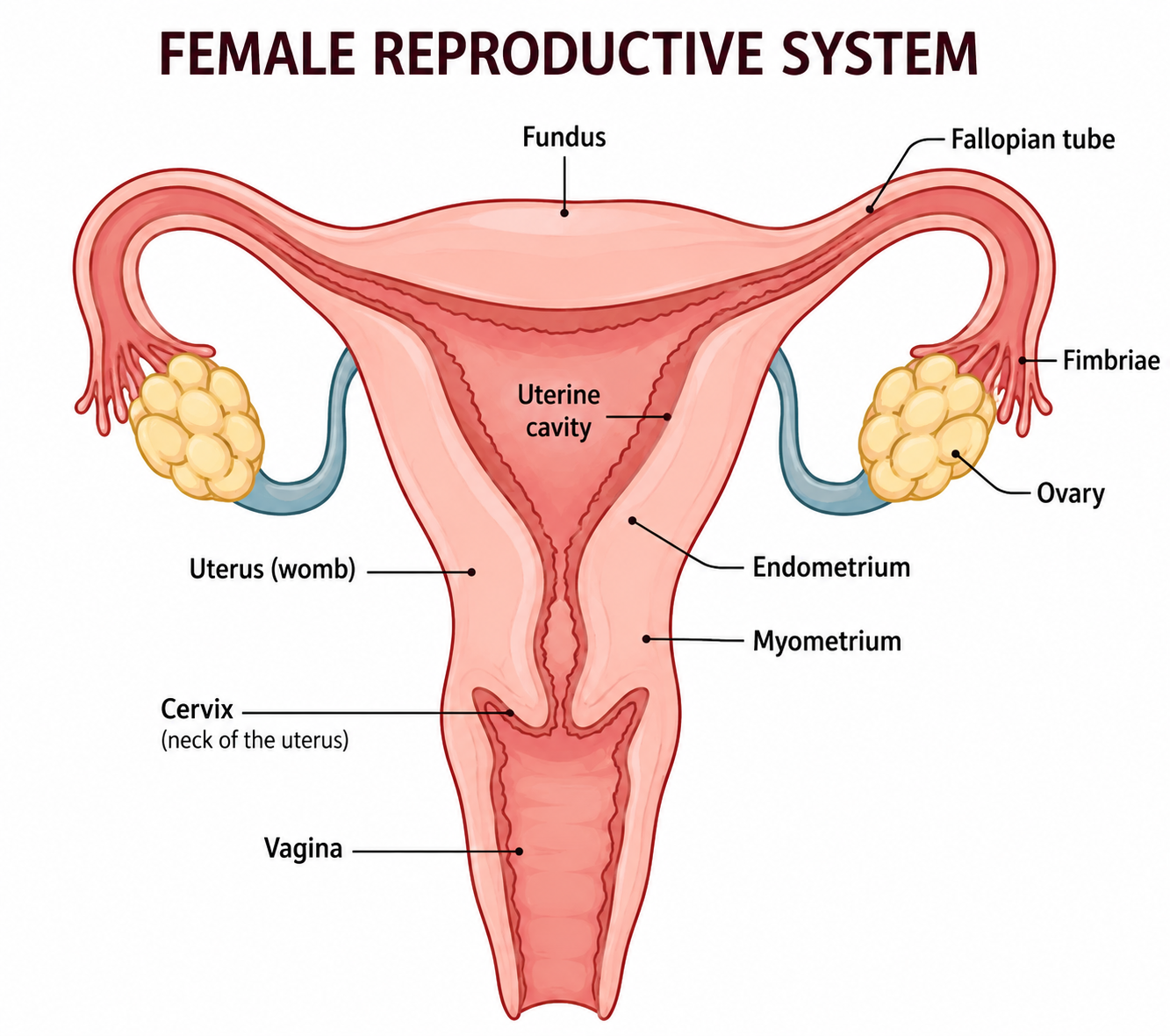
The female reproductive system is a specialized organ system that is responsible for reproduction, fertility, menstruation, and pregnancy. It consists of both internal and external reproductive organs that work together to produce female reproductive cells (ova or eggs) and the hormones estrogen and progesterone. These hormones regulate the menstrual cycle, support sexual development, and prepare the body for pregnancy. The female reproductive system also provides a safe and nourishing environment where a fertilized egg can develop into a fetus until childbirth. In addition to its role in reproduction, it contributes to overall reproductive health and the development of secondary sexual characteristics, making it an essential system for both human reproduction and hormonal balance.
The external female reproductive organs, collectively known as the vulva, form the external genitalia of the female reproductive system. They protect the internal reproductive organs from injury and infection, facilitate sexual reproduction, and contain structures involved in urination and sexual response. The vulva consists of several specialized structures, each performing a unique function.
The mons pubis is a rounded elevation of adipose (fatty) tissue situated anterior to the pubic symphysis. It acts as a protective cushion over the pubic bone and becomes covered with pubic hair after puberty under the influence of estrogen.
The labia majora are two large longitudinal folds of skin extending from the mons pubis to the perineum. They contain adipose tissue, sweat glands, sebaceous glands, and hair follicles. Their primary function is to protect the more delicate structures of the vulva against mechanical injury and microbial infection.
The labia minora are two thin, highly vascular folds of skin located medial to the labia majora. They are devoid of hair and enclose the vestibule of the vagina. Their rich blood supply and numerous nerve endings contribute to lubrication, protection, and sensory perception.
The clitoris is a small erectile organ situated at the anterior junction of the labia minora. It contains abundant sensory nerve endings and erectile tissue, making it the principal organ responsible for female sexual sensation. Structurally, it is homologous to the male penis.
The vestibule is the space enclosed by the labia minora. It contains the external openings of the urethra and vagina, as well as the ducts of the greater vestibular (Bartholin's) glands, which secrete mucus to lubricate the vaginal opening during sexual arousal.
The external urethral orifice is the opening of the urethra located within the vestibule, anterior to the vaginal opening. It serves as the passage through which urine is expelled from the urinary bladder.
The vaginal orifice is the external opening of the vagina situated below the urethral opening. It provides the passage for menstrual flow, receives the penis during sexual intercourse, and functions as the birth canal during childbirth.
The greater vestibular glands, commonly known as Bartholin's glands, are paired mucus-secreting glands located on either side of the vaginal opening. Their secretions lubricate the vestibule, reducing friction during sexual intercourse.
The internal female reproductive organs are located within the pelvic cavity and are responsible for the production of female gametes, fertilization, implantation, pregnancy, and childbirth. These organs work together under the control of reproductive hormones to ensure the continuation of human life.
The ovaries are a pair of almond-shaped reproductive glands located on either side of the uterus. They produce ova (egg cells) through oogenesis and secrete the hormones estrogen and progesterone, which regulate the female reproductive cycle and secondary sexual characteristics.
The fallopian tubes, also known as the oviducts, are two narrow muscular tubes extending from the uterus toward the ovaries. Their finger-like projections, called fimbriae, collect the ovum after ovulation. Fertilization normally takes place in the ampulla of the fallopian tube.
The uterus, commonly called the womb, is a thick-walled muscular organ situated between the urinary bladder and rectum. It provides the site for implantation of the fertilized egg and supports the growth and development of the embryo and fetus throughout pregnancy.
The cervix is the narrow, lower portion of the uterus that opens into the vagina. It acts as a passage between the uterus and vagina, secretes protective mucus, and dilates during childbirth to allow the baby to pass through.
The vagina is a highly elastic, fibromuscular canal extending from the cervix to the exterior of the body. It receives the penis during sexual intercourse, serves as the passage for menstrual flow, and forms the birth canal during delivery.
The broad ligament is a double layer of peritoneum that supports the uterus, fallopian tubes, and ovaries within the pelvic cavity. It helps maintain the proper position of the reproductive organs and provides a pathway for blood vessels and nerves.
Here are some fascinating facts about the Female Reproductive Systemss!
The female reproductive system begins developing before birth. A baby girl is born with approximately 1–2 million immature egg cells, meaning every egg she will ever have is already present at birth. By puberty, this number decreases to about 300,000–400,000, but only 400–500 eggs will typically be released during her reproductive lifetime.