Interactive Blood Vessels Labelled Illustration
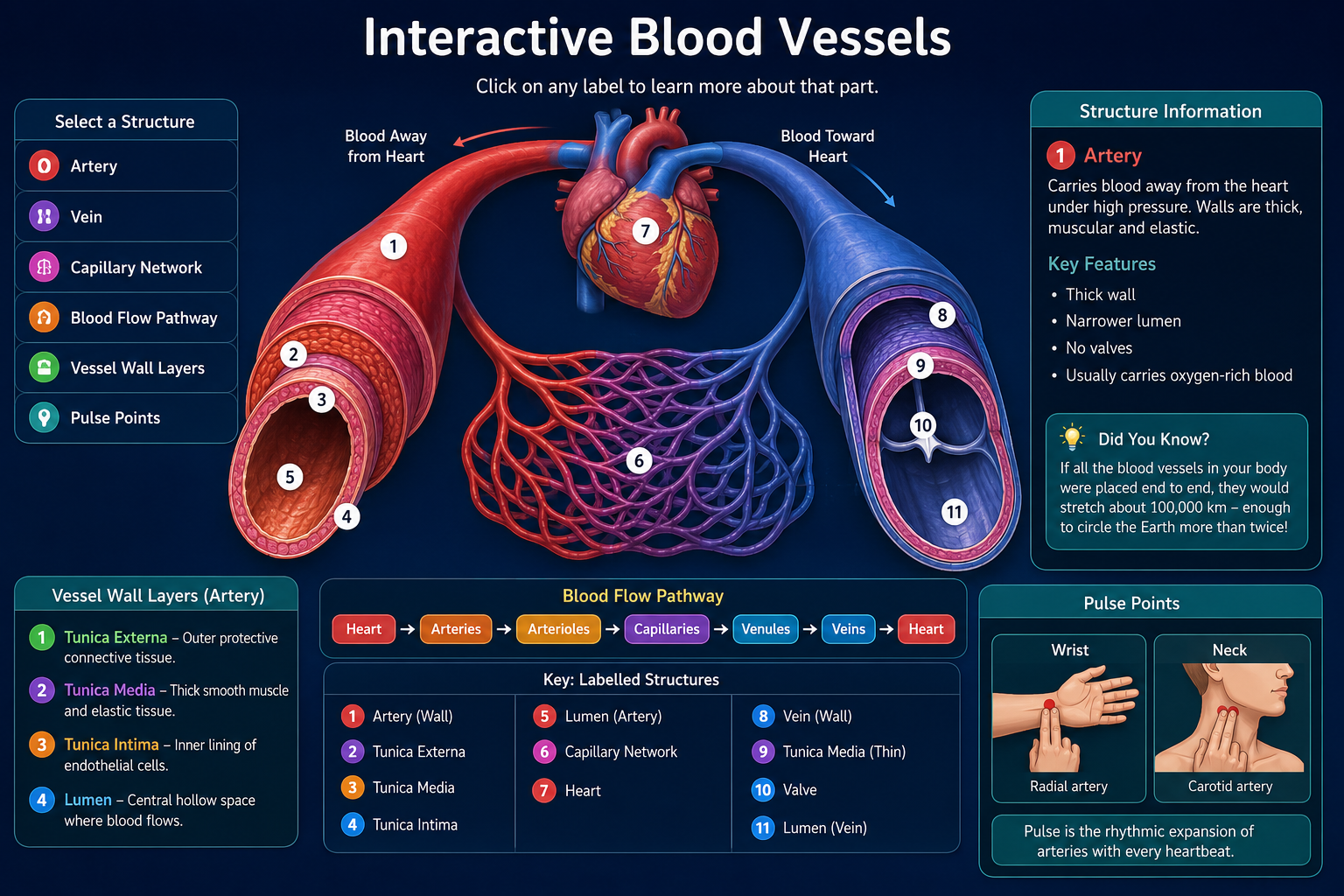
Functions of Blood Vessels
Blood vessels form an extensive network that transports blood throughout the body. They deliver oxygen and nutrients to cells, remove wastes, regulate body temperature, and help maintain normal blood pressure.
Transport Blood
Blood vessels transport oxygen-rich and oxygen-poor blood between the heart, lungs, and all parts of the body.
Deliver Oxygen
Arteries carry oxygen-rich blood to body tissues, ensuring that every cell receives the oxygen needed for cellular respiration.
Supply Nutrients
Blood vessels transport glucose, amino acids, vitamins, minerals, and other nutrients required for growth, repair, and energy production.
Remove Wastes
Veins carry blood containing carbon dioxide and other metabolic wastes away from body tissues for elimination.
Regulate Blood Pressure
Blood vessels can constrict or dilate, helping maintain a healthy blood pressure throughout the body.
Control Body Temperature
Blood vessels help regulate body temperature by adjusting blood flow near the skin through vasodilation and vasoconstriction.
Support Immunity
Blood vessels transport white blood cells and antibodies to sites of infection, helping the body fight harmful microorganisms.
Carry Hormones
Blood vessels transport hormones released by endocrine glands to target organs throughout the body.
Types of Blood Vessels
The circulatory system contains three main types of blood vessels. Although they work together, each has a unique structure and function that helps maintain efficient blood circulation throughout the body.
Arteries
Carry blood away from the heart under high pressure.
Veins
Return blood back to the heart with the help of valves.
Capillaries
Tiny blood vessels where gas and nutrient exchange occurs.
Structure of a Blood Vessel
Although arteries and veins differ in thickness and function, most blood vessels share a similar basic structure. Their walls are composed of three distinct layers surrounding a central passage called the lumen.
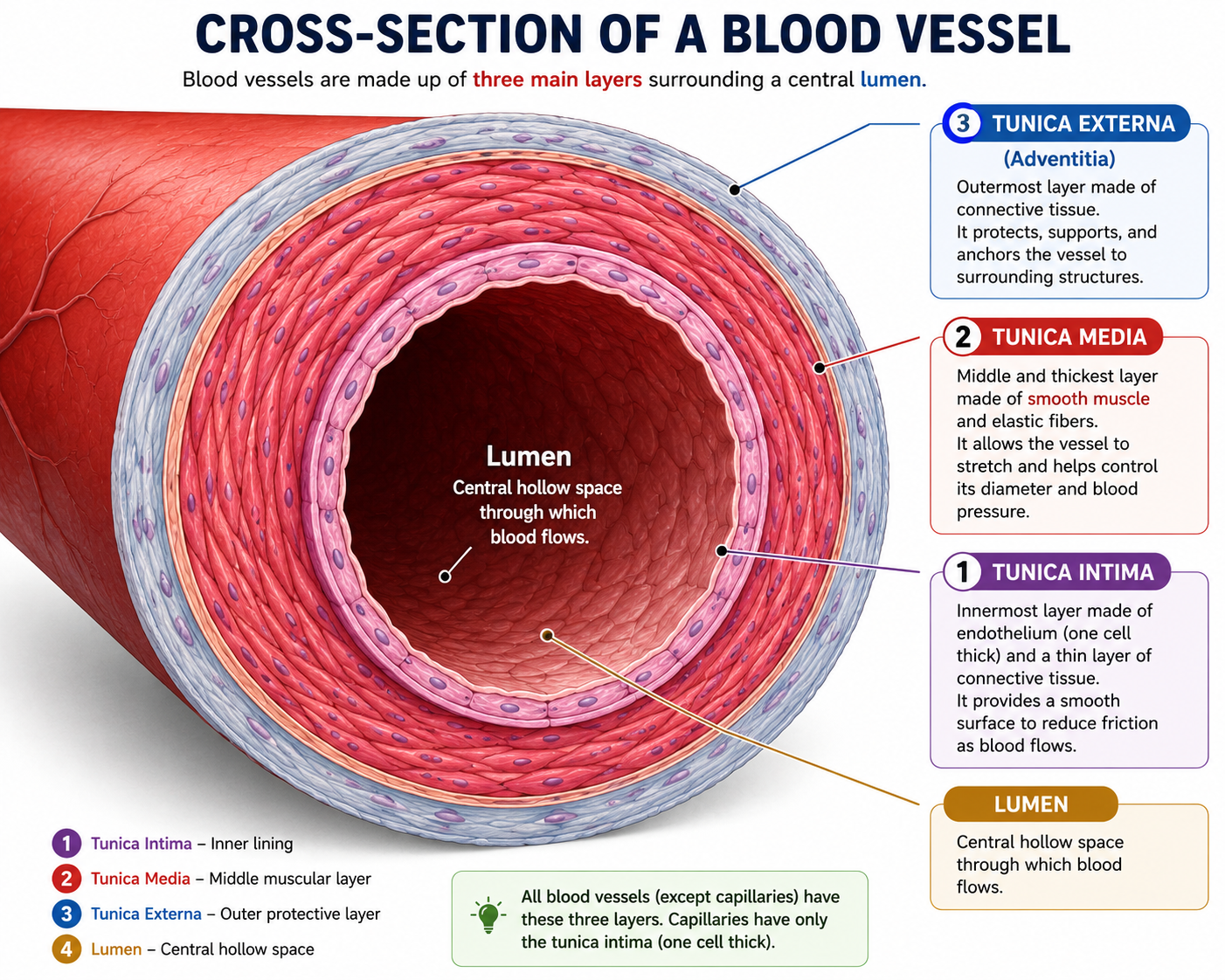
Tunica Intima
The innermost layer of the blood vessel, made of a thin sheet of endothelial cells. Its smooth surface reduces friction and allows blood to flow easily.
Tunica Media
The middle layer, composed mainly of smooth muscle and elastic fibers. It controls the diameter of the blood vessel through vasoconstriction and vasodilation.
Tunica Externa
The outermost protective layer, consisting of connective tissue that strengthens and anchors the blood vessel to surrounding structures.
Lumen
The central hollow space through which blood flows. Arteries usually have a narrower lumen, while veins have a wider lumen.
Arteries vs Veins vs Capillaries
Although all blood vessels transport blood throughout the body, they differ in structure, function, and the type of blood flow they support. The table below highlights their major differences.
| Feature | 🔴 Arteries | 🔵 Veins | 🟣 Capillaries |
|---|---|---|---|
| Direction of Blood Flow | Away from the heart | Toward the heart | Connect arteries and veins |
| Type of Blood | Usually oxygen-rich | Usually oxygen-poor | Exchange of oxygen and carbon dioxide occurs |
| Wall Thickness | Thick, muscular, and elastic | Thin and less muscular | One cell thick |
| Lumen | Narrow | Wide | Extremely narrow |
| Valves | ❌ No | ✅ Yes | ❌ No |
| Blood Pressure | High | Low | Very Low |
| Blood Flow Speed | Fast | Moderate | Very Slow |
| Main Function | Deliver blood from the heart | Return blood to the heart | Exchange gases, nutrients, and wastes |
| Examples | Aorta, Carotid Artery | Vena Cava, Jugular Vein | Capillary Beds |
Blood Flow Through Blood Vessels
Blood continuously circulates throughout the body in a closed loop. It leaves the heart through arteries, exchanges oxygen and nutrients in the capillaries, and returns to the heart through veins.
Heart
Pumps blood with force into the arteries.
Arteries
Carry blood away from the heart.
Capillaries
Exchange oxygen, nutrients, carbon dioxide, and waste products.
Veins
Return blood back to the heart.
Heart
The cycle begins again with every heartbeat.
Exchange in Capillaries
Capillaries are the main sites of exchange between the blood and body tissues. Their walls are only one cell thick, allowing oxygen, nutrients, carbon dioxide, and wastes to move easily by diffusion.
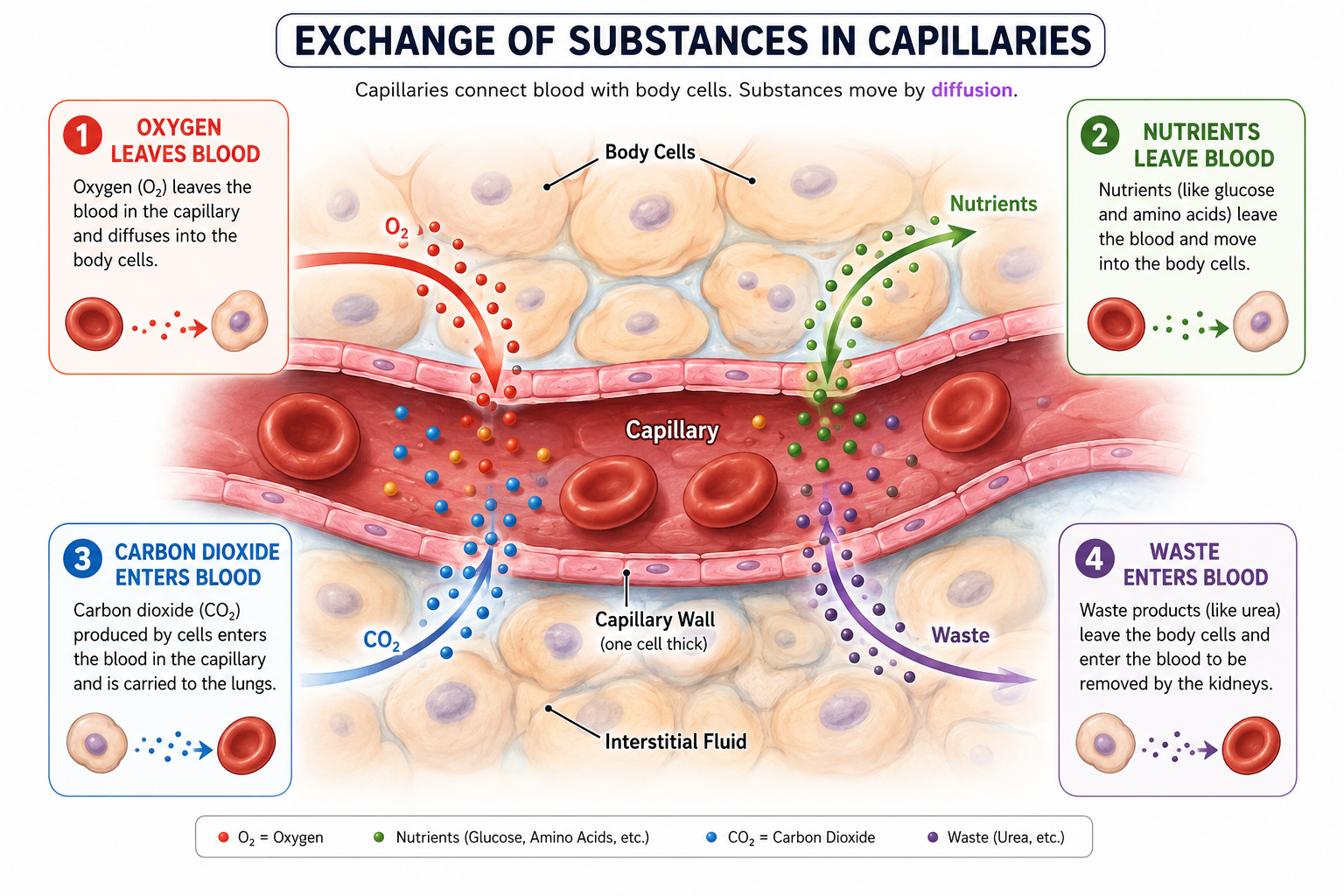
Oxygen Leaves Blood
Oxygen diffuses from the blood through the capillary wall into nearby body cells, where it is used for cellular respiration.
Nutrients Leave Blood
Nutrients such as glucose, amino acids, vitamins, and minerals pass from the blood into surrounding tissues to support growth and energy production.
Carbon Dioxide Enters Blood
Carbon dioxide produced by cells diffuses into the blood and is transported to the lungs for removal during exhalation.
Waste Enters Blood
Metabolic waste products such as urea enter the bloodstream and are carried to organs like the kidneys for excretion.
💡 Key Concept
Capillaries act as the bridge between the blood and body cells. Without this exchange, cells would not receive oxygen and nutrients, and harmful wastes would accumulate in the body.
Blood Pressure
Blood pressure is the force exerted by circulating blood against the walls of the arteries. It is measured in millimeters of mercury (mmHg) and is expressed as two values: systolic pressure over diastolic pressure.
Systolic Pressure
The higher number in a blood pressure reading. It represents the pressure inside the arteries when the heart contracts and pumps blood to the body.
Diastolic Pressure
The lower number in a blood pressure reading. It represents the pressure inside the arteries when the heart relaxes between two beats.
🩺 Normal Blood Pressure
A normal blood pressure reading for a healthy adult is approximately 120/80 mmHg.
Pulse
The pulse is the rhythmic expansion and recoil of an artery caused by the pumping action of the heart. Every heartbeat creates a pressure wave that travels through the arteries and can be felt at certain points of the body.
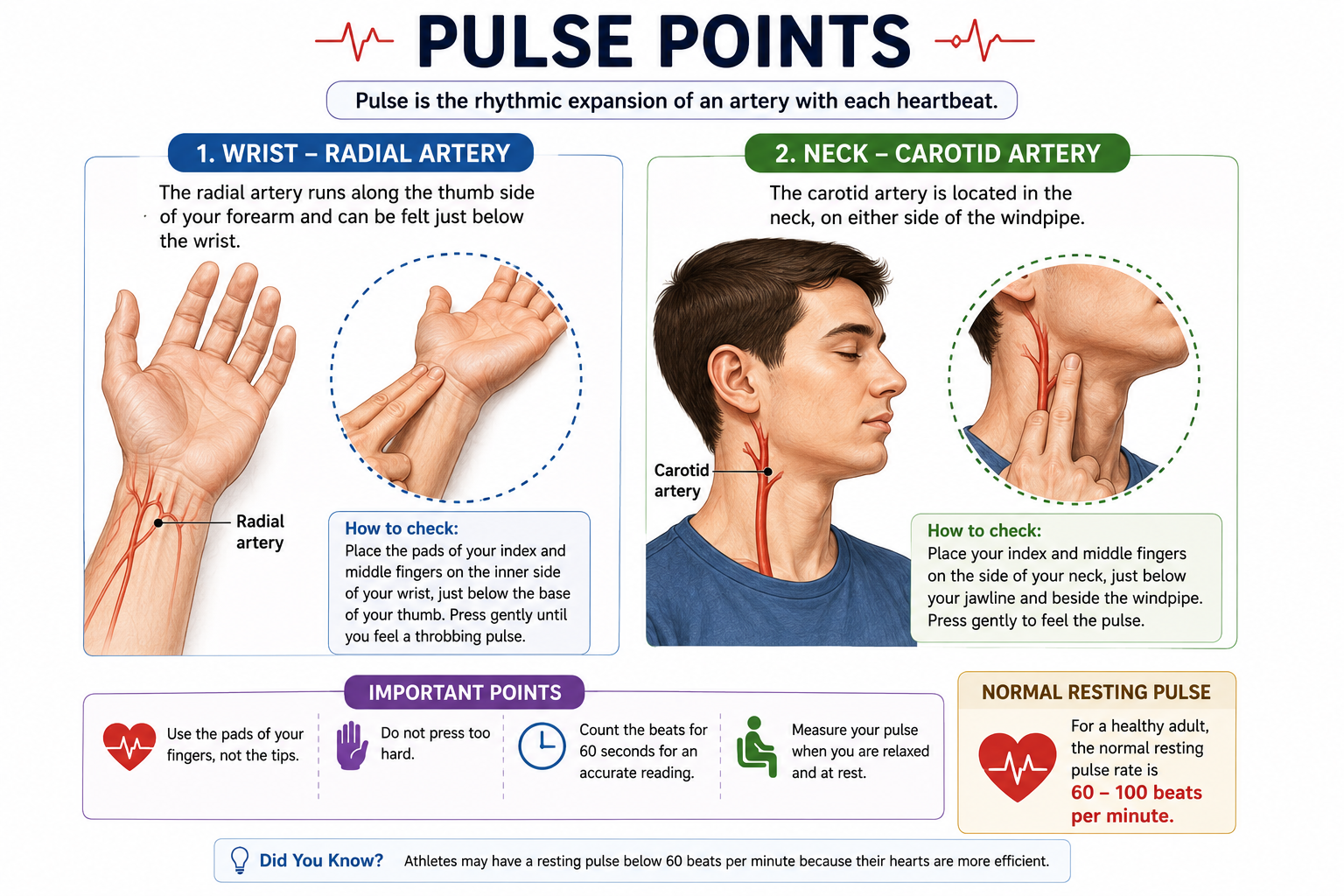
What is Pulse?
A pulse is the pressure wave produced when the left ventricle contracts and pushes blood into the aorta. This wave travels through the arteries and can be felt wherever an artery lies close to the skin.
Where to Check the Pulse?
The pulse is commonly checked at the wrist (radial artery) and the neck (carotid artery), where arteries are close to the skin and easy to feel.
Normal Resting Pulse
A healthy adult usually has a resting pulse of 60–100 beats per minute (bpm). Well-trained athletes may have a resting pulse as low as 40–60 bpm.
📍 Common Pulse Points
Wrist
Feel the radial artery on the thumb side of your wrist using your index and middle fingers.
Neck
Feel the carotid artery gently on either side of the neck beside the windpipe.
💡 Did You Know?
Your pulse rate usually matches your heart rate. During exercise, fear, excitement, or illness, the pulse becomes faster because the heart pumps more blood to meet the body's increased demand for oxygen.
Amazing Blood Vessels Facts
Here are some fascinating facts about the blood vessels that keep your body alive every second!
If all the blood vessels in your body were placed end to end, they would stretch for about 100,000 kilometers (60,000 miles)—enough to circle the Earth more than twice!
The aorta is the largest artery in the human body and carries oxygen-rich blood directly from the heart.
The vena cava is the largest vein in the body, returning blood back to the heart.
Capillaries are so tiny that red blood cells must travel through them one at a time.
Your blood completes one full trip around your body in about one minute while resting.
Arteries have thick muscular walls because blood leaving the heart travels under high pressure.
The valves inside your veins prevent blood from flowing backward, especially in your legs.
The pulmonary artery is the only artery that carries oxygen-poor blood.
The pulmonary veins are the only veins that carry oxygen-rich blood.
Blood vessels help regulate your body temperature by widening and narrowing.
During exercise, blood vessels supplying muscles widen to deliver more oxygen and nutrients.
Your brain receives about 15–20% of your heart's blood supply every minute.
The heart has its own blood vessels called the coronary arteries that supply oxygen to the heart muscle.
The wall of a capillary is only one cell thick, allowing rapid exchange of materials.
Nutrients such as glucose and amino acids leave the blood through capillaries to nourish body cells.
Waste products like urea enter the bloodstream through capillaries before being removed by the kidneys.
Your pulse is simply the expansion of arteries each time the heart pumps blood.
Doctors often check your pulse at the wrist or neck because arteries are close to the skin there.
Healthy blood pressure for most adults is around 120/80 mmHg.
Every single cell in your body is located very close to a capillary, ensuring it receives oxygen and nutrients.
💡 Did you know?
If just one capillary in your body were enlarged to the diameter of a garden hose, a single red blood cell would become about the size of a grapefruit. Despite being microscopic, your body contains billions of these tiny exchange stations, silently keeping every cell alive.