Skeletal System
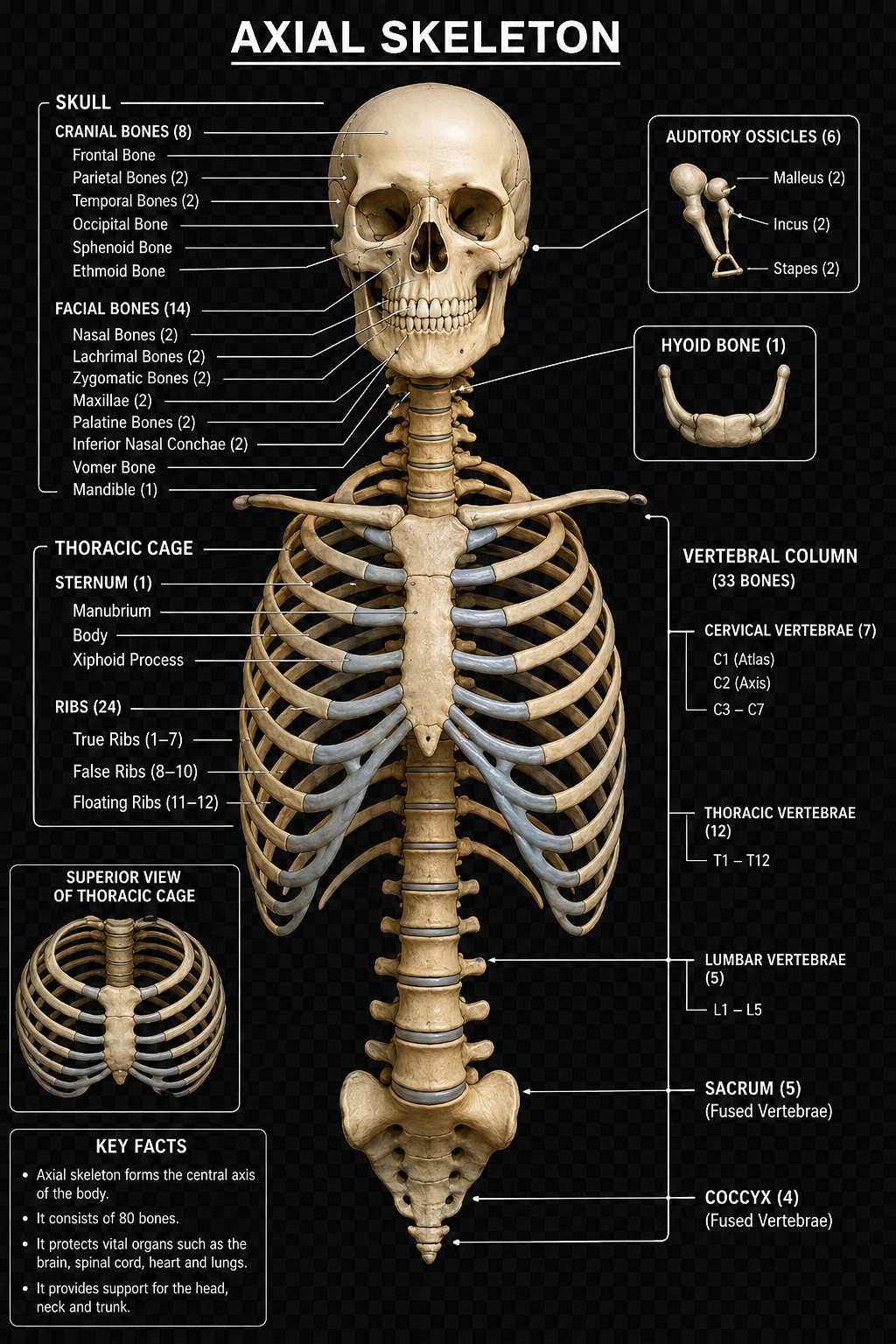
The axial skeleton is the central framework of the human body and forms the body's main supporting axis. It consists of 80 bones, including the skull, vertebral column (spine), rib cage, and sternum (breastbone). These bones provide strength and stability, allowing the body to maintain an upright posture while supporting the weight of the head, neck, and trunk. The axial skeleton also protects many of the body's most important organs, such as the brain, spinal cord, heart, and lungs, from injury. In addition, it serves as an attachment point for numerous muscles involved in breathing, head and neck movement, and maintaining proper body posture. Because it forms the core of the skeletal system, the axial skeleton provides the foundation upon which the rest of the body's bones are connected.
The axial skeleton forms the central framework of the body and performs several essential functions that support life and protect vital organs.
The axial skeleton protects delicate organs such as the brain, spinal cord, heart, and lungs from injury. The skull encloses the brain, the vertebral column surrounds the spinal cord, and the thoracic cage shields the heart and lungs.
It forms the central axis of the body, supporting the head, neck, and trunk while providing a strong framework that maintains the body's shape and stability.
Numerous muscles attach to the bones of the axial skeleton. These attachments allow movements of the head, neck, vertebral column, and rib cage, while also assisting in body posture.
The thoracic cage works with the intercostal muscles to expand and contract during breathing, allowing the lungs to fill with air and empty during respiration.
The vertebral column helps maintain an upright posture and balances the weight of the head and upper body during standing, sitting, and walking.
Many important muscles of the neck, back, chest, and abdomen are attached to the axial skeleton, providing strength and stability during movement.
The axial skeleton consists of five major parts that form the central axis of the human body. Together, they provide support, protection, and attachment sites for muscles.
The skull consists of 22 bones that protect the brain and support the structures of the face. It is divided into the cranial bones and facial bones.
The vertebral column, commonly called the spine, is made up of 33 vertebrae. It supports the body's weight, protects the spinal cord, and allows flexibility and movement.
The thoracic cage consists of the sternum and 12 pairs of ribs. It protects the heart and lungs while assisting in the process of breathing.
The auditory ossicles are three tiny bones in each middle ear—malleus, incus, and stapes. They transmit sound vibrations from the eardrum to the inner ear.
The hyoid bone is a U-shaped bone located in the neck. Unlike other bones, it does not articulate with any other bone and supports the tongue while aiding speech and swallowing.
The axial skeleton is composed of five major parts, each having a specific number of bones and performing important functions that support and protect the human body.
| Part | Number of Bones | Main Function |
|---|---|---|
| 💀 Skull | 22 | Protects the brain, supports the face, and houses sensory organs. |
| 🦴 Vertebral Column | 33 Vertebrae | Supports the body, protects the spinal cord, and maintains posture. |
| 🫁 Thoracic Cage | 25 (24 Ribs + 1 Sternum) |
Protects the heart and lungs and assists in breathing. |
| 🦻 Auditory Ossicles | 6 (3 in each ear) |
Transmit and amplify sound vibrations for hearing. |
| 🗣️ Hyoid Bone | 1 | Supports the tongue and aids in speech and swallowing. |
| Total | 80 Bones | Forms the body's central axis, provides support, protects vital organs, and serves as muscle attachment. |
The bones of the axial skeleton are connected by different types of joints and supporting structures. These connections provide stability, protection, flexibility, and allow limited movement where necessary.
Sutures are immovable fibrous joints that connect the bones of the skull. They interlock the cranial bones tightly, forming a strong protective case around the brain. In infants, these joints are flexible and gradually fuse as growth is completed.
Intervertebral discs are pads of fibrocartilage located between adjacent vertebrae. They act as shock absorbers, reduce friction between bones, and allow the vertebral column to bend and twist while protecting the spinal cord.
Costal cartilage is a flexible cartilage that connects the ribs to the sternum. It increases the flexibility of the thoracic cage, allowing it to expand and contract during breathing.
Strong ligaments connect many bones of the axial skeleton, especially in the vertebral column. They stabilize joints, limit excessive movement, and help maintain proper alignment of the spine.
Here are some fascinating facts about the Axial Skeleton!