Interactive Appendicular-Skeleton Labelled Illustration
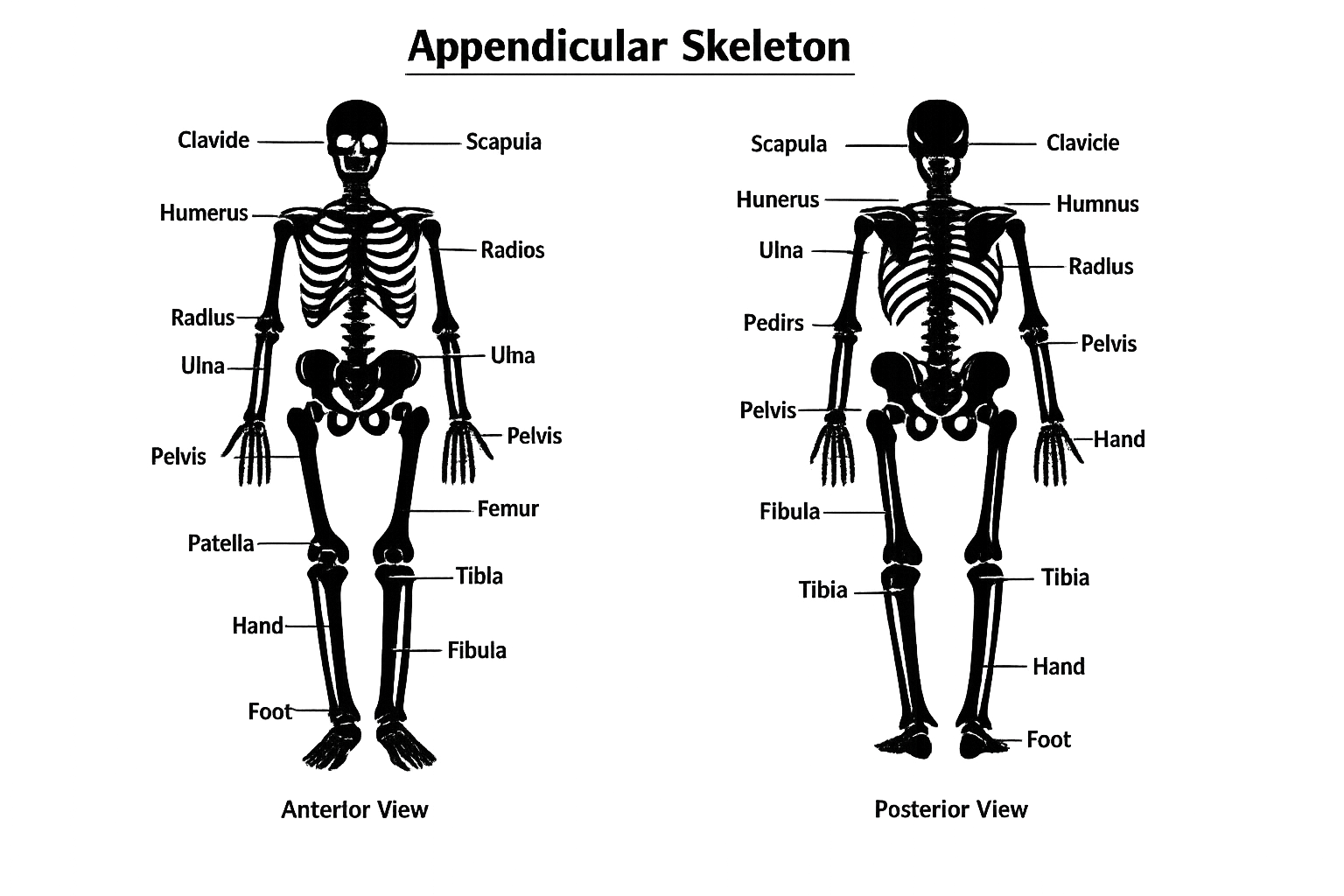
The appendicular skeleton consists of 126 bones and includes the upper limbs, lower limbs, pectoral (shoulder) girdle, and pelvic (hip) girdle. It is responsible for connecting the limbs to the axial skeleton and plays a vital role in movement, locomotion, and maintaining balance. The bones of the upper limbs allow us to grasp, lift, and manipulate objects, while the lower limbs support the body's weight and enable activities such as walking, running, and jumping. In addition, the appendicular skeleton provides attachment points for numerous muscles, making coordinated body movements possible. Working together with the axial skeleton, it gives the body flexibility, mobility, and stability during everyday activities.
The appendicular skeleton is primarily responsible for movement and interaction with the surrounding environment. It connects the limbs to the axial skeleton and provides support, flexibility, and attachment for powerful muscles.
The appendicular skeleton provides the framework for the upper and lower limbs, allowing a wide range of movements such as walking, running, jumping, lifting, and grasping objects.
The bones of the appendicular skeleton serve as attachment sites for numerous skeletal muscles. When these muscles contract, they pull on the bones to produce smooth and controlled body movements.
The bones of the upper limbs, especially the hands and fingers, allow humans to perform precise movements such as writing, holding tools, typing, and performing delicate tasks.
The pelvic girdle and lower limbs bear the body's weight while standing, walking, and running. They also help maintain balance and stability during movement.
The appendicular skeleton works together with muscles and joints to maintain body balance, coordinate movement, and keep the body stable during various physical activities.
The pectoral girdle connects the upper limbs to the axial skeleton, while the pelvic girdle connects the lower limbs. These girdles provide both mobility and stability for efficient movement.
The appendicular skeleton consists of 126 bones arranged into two major divisions. These divisions connect the limbs to the axial skeleton and are mainly responsible for body movement, stability, and manipulation of objects.
The upper appendicular skeleton consists of the pectoral (shoulder) girdle and the upper limbs. It provides a wide range of motion, allowing activities such as lifting, throwing, writing, grasping, and performing precise hand movements.
The lower appendicular skeleton consists of the pelvic girdle and the lower limbs. It supports the body's weight, maintains balance, and enables locomotion such as walking, running, jumping, and climbing.
Although both divisions belong to the appendicular skeleton, they differ in structure, function, and mobility. The upper appendicular skeleton is mainly adapted for flexibility and manipulation, whereas the lower appendicular skeleton is specialized for support, balance, and locomotion.
| Feature | Upper Appendicular Skeleton | Lower Appendicular Skeleton |
|---|---|---|
| Major Components | Pectoral girdle and upper limbs | Pelvic girdle and lower limbs |
| Number of Bones | 64 bones | 62 bones |
| Main Function | Manipulation of objects and precise movements | Support, balance, and locomotion |
| Mobility | Highly flexible with a wide range of motion | Less flexible but much stronger and more stable |
| Weight Bearing | Does not bear body weight | Bears the body's weight during standing and walking |
| Largest Bone | Humerus | Femur |
| Major Girdle | Pectoral (Shoulder) Girdle | Pelvic (Hip) Girdle |
| Common Activities | Writing, lifting, grasping, throwing, typing | Walking, running, jumping, climbing, standing |
| Primary Purpose | Movement and manipulation | Support and locomotion |
The bones of the appendicular skeleton are connected by strong joints, ligaments, and cartilage that provide both stability and a wide range of movement. These connections allow the limbs to perform powerful and precise actions while supporting the body's weight.
Most bones of the appendicular skeleton are connected by synovial joints, which are freely movable joints. These joints are found in the shoulders, elbows, wrists, hips, knees, ankles, and fingers. They allow movements such as bending, straightening, rotating, and swinging of the limbs.
Ligaments are strong bands of connective tissue that connect one bone to another. They strengthen joints, maintain proper alignment of bones, and prevent excessive movements that could cause injury.
The ends of bones in synovial joints are covered with articular cartilage. This smooth cartilage reduces friction between bones and absorbs shocks during movements such as walking, running, and jumping.
The pectoral girdle connects the upper limbs to the axial skeleton, providing excellent mobility. The pelvic girdle connects the lower limbs to the axial skeleton and provides greater strength and stability to support body weight.
Here are some fascinating facts about the Appendicular Skeleton!